
The Sanctioned Sanctuary: How Economic Pressure Creates Refugee Magnets
In
Login if you are already registered
(votes: 2, rating: 5) |
(2 votes) |

Lecturer at the RUDN University
As the global population of refugees reached a record high of 37.8 million as of mid-2024, a staggering 16 percent—nearly one in six—originated from Afghanistan, where people have fled decades of civil war, persecution, and state collapse. Almost 90 percent of the world's 6.1 million Afghan refugees live in neighboring Iran or Pakistan, with Iran hosting the largest share. As of mid-2024, Iran was the world's largest refugee host, sheltering 3.8 million people, of whom 99 percent were from Afghanistan, alongside small numbers from Iraq and other countries.
This reality presents a striking paradox: despite an enduring escalation in international sanctions since 1979, Iran has absorbed successive waves of Afghan refugees, with migration flows intensifying precisely during periods of heightened geopolitical pressure. The relationship between sanctions and migration flows to Iran defies conventional wisdom, revealing that sanctions function not merely as instruments of targeted pressure but as catalysts for regional destabilization that indirectly drive migration toward the sanctioned state.
The paradox resolves when examining Iran's “relative stability” compared to its immediate neighbors, particularly Afghanistan. While Iran's inflation averaged 32.06% in 2024—a significant economic challenge—Afghanistan experienced a deflationary collapse of -7.76% in the same year, reflecting systemic economic disintegration rather than mere instability. This stark contrast underscores Iran's position as a “least-worst option” for displaced Afghans seeking refuge. Economic indicators further illuminate this disparity: Iran's GDP per capita was estimated at approximately $4,630 in 2024, while Afghanistan's stood at a mere $409.01, representing an eleven-fold difference in economic capacity. Within this context, Iran's informal sector, though strained by international sanctions, offered Afghan refugees wages of approximately $4 per day in construction work—triple the post-2021 minimum wage in Afghanistan.
Unlike Iran's sanctions—which primarily affected its own economy—these measures against Afghanistan directly destroyed the country's governance capacity, banking infrastructure, and humanitarian lifelines, creating the precise conditions that forced 500,000 Afghans to seek refuge in Iran during 2021 alone. This represents not merely a regional migration pattern but a direct causal chain: sanctions on Afghanistan's financial system contribute to economic collapse, that contribute to a humanitarian catastrophe, resulting in refugee flows toward neighboring countries with relatively functioning economies, including Iran.
This phenomenon demonstrates that sanctions operate not merely as targeted economic policy instruments but also as catalysts for regional destabilization with unintended humanitarian consequences that ripple across borders. While direct sanctions on Afghanistan triggered an immediate economic collapse and mass displacement, sanctions on Iran paradoxically contributed to refugee flows by destabilizing the broader region, while Iran maintained relative stability compared to Afghanistan's complete governance collapse.
As the global population of refugees reached a record high of 37.8 million as of mid-2024, a staggering 16 percent—nearly one in six—originated from Afghanistan, where people have fled decades of civil war, persecution, and state collapse. Almost 90 percent of the world's 6.1 million Afghan refugees live in neighboring Iran or Pakistan, with Iran hosting the largest share. As of mid-2024, Iran was the world's largest refugee host, sheltering 3.8 million people, of whom 99 percent were from Afghanistan, alongside small numbers from Iraq and other countries.
This reality presents a striking paradox: despite an enduring escalation in international sanctions since 1979, Iran has absorbed successive waves of Afghan refugees, with migration flows intensifying precisely during periods of heightened geopolitical pressure. The relationship between sanctions and migration flows to Iran defies conventional wisdom, revealing that sanctions function not merely as instruments of targeted pressure but as catalysts for regional destabilization that indirectly drive migration toward the sanctioned state.
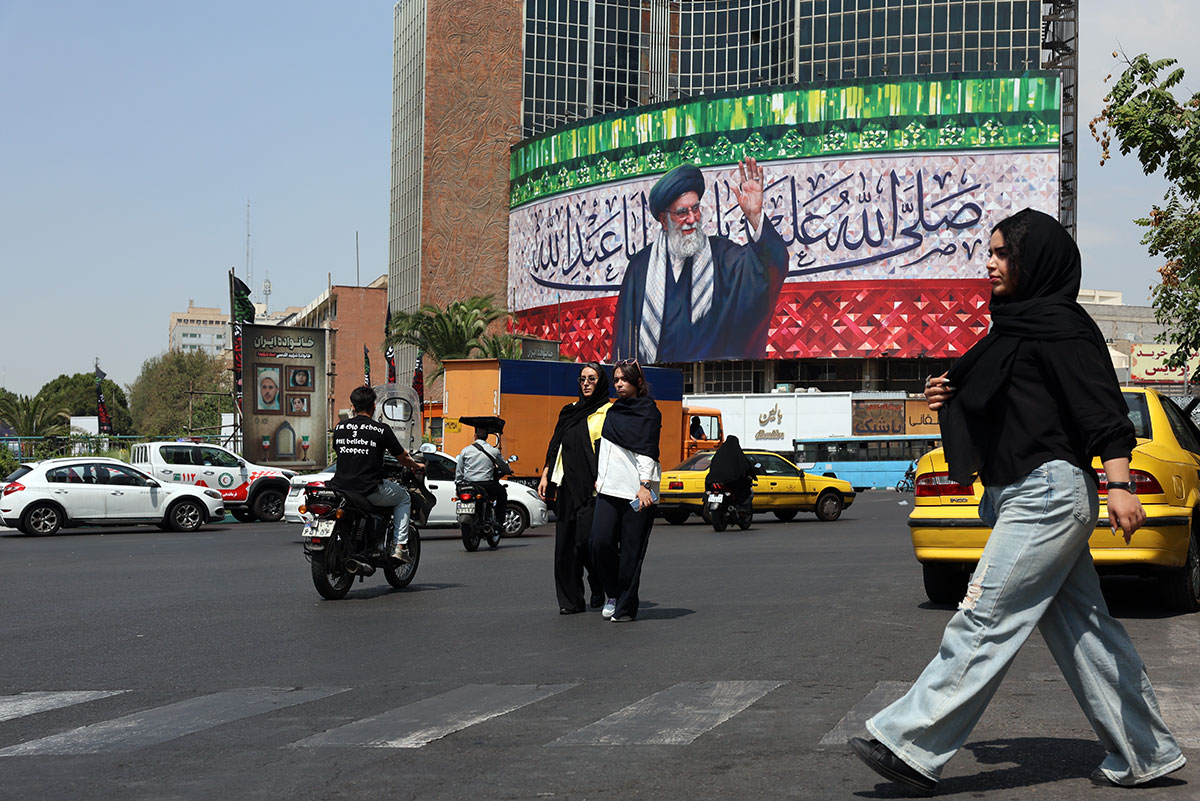
Iran's New Identity: Patriotism vs. Islamism
The historical pattern of Afghan migration to Iran reveals five distinct periods corresponding to different moments of unrest in Afghanistan and changing policy priorities in Iran.
The first major wave followed the Saur Revolution in 1978—a communist coup—and the Soviet Union's 1979 invasion to support the struggling communist regime. During this period, Iran's new government encouraged sheltering Afghans, issuing “Blue Cards” that granted them the status of immigrants (mohajerin) and rights similar to Iranian citizens. Between 1979 and 1988, the number of refugees and other displaced people in Iran increased from 130,000 to nearly 2.9 million. This initial welcoming policy coincided with the Islamic Revolution in Iran and reflected both religious solidarity with fellow Muslims resisting communist oppression and practical necessity, as the new government needed a labor force while having limited border control resources.
The second wave occurred from 1989 to 1996, following the Soviet withdrawal and the subsequent civil war in Afghanistan. With the Mujahideen forcing Soviet forces to withdraw by 1989, and the communist government in Kabul collapsing in 1992, intense power struggles led to brutal civil conflict. Iran maintained its open-door policy during this period, facilitating Afghan student admission into Iranian universities through a 1990 Resolution by the High Council of Education. By 1990, the refugee population neared 4.2 million, prompting Iran to gradually phase out the blue card system due to resource constraints. In 1992, Iran launched its first formal repatriation program through a tripartite agreement with UNHCR and the new Afghan government, enabling the return of 1.4 million Afghans and reducing the refugee population to around 2.5 million by 1993.
The Taliban's rise [1] from 1996 to 2001 triggered the third major migration period. As the Taliban controlled approximately 80 percent of Afghanistan by 1996, imposing extreme interpretations of Islamic law and committing atrocities against ethnic minorities like the Hazaras, Iran's response became significantly less welcoming. In 1995, Iran imposed stricter border controls, allowing entry only to Afghans meeting the 1951 Refugee Convention criteria. This policy shift reflected the economic strains felt by the country after hosting millions of Afghans for over two decades, in addition to demands from Iran's baby boomer generation, mounting international sanctions—particularly on Iran's petroleum industry—and rising security concerns as Iran supported anti-Taliban groups. Newly arriving Afghans were predominantly admitted as temporary refugees, facilitating later repatriation efforts. The refugee population remained steady at around 2 million during this period.
The U.S.-led campaign against Iran, following the September 11 attacks and Operation Enduring Freedom, initiated the fourth migration wave. In 2003, Iran introduced the Amayesh card system as the sole method for issuing temporary residence permits to Afghan refugees, causing the Afghan population in Iran to drop from around 1.9 million in 2001 to under 1 million in 2003. The Amayesh cards required annual renewal with associated fees, and since 2007, the system focused primarily on renewals, making it increasingly difficult for new arrivals to obtain documentation. Missing renewal periods carried serious consequences, including the potential loss of legal status and deportation. As NATO prepared to transfer control to the Afghan government, Iran expanded repatriation efforts, with more than 18,500 Afghans returning through voluntary programs in 2011, while approximately 150,000 individuals were deported.

Afghanistan and Regional Security: Scenarios for the Future
The fifth and most recent wave began in 2021, following the Taliban's return to power after U.S. and allied forces withdrew from Afghanistan. More than 1 million Afghans fled to Iran, in what constitutes the swiftest exodus of Afghanistan's modern era, for fear of persecution—particularly those who had worked with international organizations, belonged to minority ethnic groups like the Hazaras, or were women apprehensive about rolled-back rights under Taliban rule. These refugees arrived under Iran's most restrictive policies to date, against a backdrop of rising inflation, escalating poverty, and high unemployment, exacerbated by U.S.-led sanctions and the impact of the COVID-19 pandemic. Most entered without authorization as Iran tightened its border controls and drastically limited new Amayesh card issuance. In 2022, Iran launched a headcount and identification census for unauthorized Afghans, granting temporary legal status under the Conditional Protection Preparation Process, with status validity extended until March 20, 2025. Meanwhile, deportations surged significantly, with an estimated 485,000 Afghans deported in 2022, more than 651,000 in 2023, and 750,000 in 2024. According to an Al Jazeera July 22, 2025 Report, Iran has announced plans to deport up to 2 million Afghans lacking legal status by March 2025, reflecting a dramatic policy shift from earlier, more welcoming approaches.
This historical progression reveals a critical pattern: periods of intensified sanctions against Iran correlate with increased migration flows to the country, though the causal mechanism operates indirectly through regional destabilization rather than direct economic hardship within Iran. The subjective scale of sanctions against Iran shows two significant peaks: 2002-2013 (post-9/11 and pre-JCPOA) and 2018-2023 (post-JCPOA withdrawal). These periods align precisely with critical escalations in Afghan instability. During 2002-2013, U.S. sanctions on Iran coincided with NATO's surge in Afghanistan, when Afghanistan's inflation spiked to 26.42% in 2008, displacing 1 million additional Afghans to Iran by 2013. From 2018-2023, reimposed U.S. sanctions targeting Iran's petroleum sector overlapped with the Taliban's 2021 takeover of Afghanistan, when Afghanistan's inflation reached 10.6% in 2022, triggering a new influx of 1 million Afghans to Iran—a 34% increase in refugee numbers.
The paradox resolves when examining Iran's “relative stability” compared to its immediate neighbors, particularly Afghanistan. While Iran's inflation averaged 32.06% in 2024—a significant economic challenge—Afghanistan experienced a deflationary collapse of -7.76% in the same year, reflecting systemic economic disintegration rather than mere instability. This stark contrast underscores Iran's position as a “least-worst option” for displaced Afghans seeking refuge. Economic indicators further illuminate this disparity: Iran's GDP per capita was estimated at approximately $4,630 in 2024, while Afghanistan's stood at a mere $409.01, representing an eleven-fold difference in economic capacity. Within this context, Iran's informal sector, though strained by international sanctions, offered Afghan refugees wages of approximately $4 per day in construction work—triple the post-2021 minimum wage in Afghanistan.
Educational infrastructure presents another critical dimension of comparative stability; Iran's literacy rate reached 90.7% in 2024, compared to Afghanistan's 37.1% as of the latest 2022 statistics. Crucially, unlike Afghanistan's complete governmental collapse following the Taliban's 2021 takeover, Iran's authoritarian governance structure maintained institutional continuity despite domestic economic pressures, providing refugees with a degree of predictability regarding security, basic services, and potential livelihoods—even amidst currency devaluation and international pressures. This relative institutional resilience, paradoxically sustained despite decades of sanctions, explains why Iran continues to absorb refugees even as its own economic conditions deteriorate.

Short Wars, Long Lessons
Crucially, sanctions imposed directly on Afghanistan—not Iran—represent the primary driver of recent refugee flows, with the U.S. freezing of Afghan central bank assets serving as the most immediate catalyst for the 2021-2022 exodus. Following the Taliban's August 2021 takeover, President Biden issued Executive Order 14064 on February 11, 2022, which froze approximately $9.5 billion in assets of Da Afghanistan Bank (DAB) held in U.S. financial institutions—a move that effectively paralyzed Afghanistan's entire financial system. This action came after decades of U.S. economic dominance in Afghanistan, where foreign aid constituted 75% of the national budget during the 2001-2021 period.
Unlike Iran's sanctions—which primarily affected its own economy—these measures against Afghanistan directly destroyed the country's governance capacity, banking infrastructure, and humanitarian lifelines, creating the precise conditions that forced 500,000 Afghans to seek refuge in Iran during 2021 alone. This represents not merely a regional migration pattern but a direct causal chain: sanctions on Afghanistan's financial system contribute to economic collapse, that contribute to a humanitarian catastrophe, resulting in refugee flows toward neighboring countries with relatively functioning economies, including Iran.
Iran's evolving policies regarding refugees to mitigate sanction pressures—from the initial blue cards granting near-citizen status to the restrictive Amayesh system and current deportation campaigns—reflect an adaptive strategy responding to cumulative economic strain. The recent intensification of deportations, with Iran's 2025 campaign targeting 2 million Afghans, represents a culmination of a decades-worth policy evolution, from welcoming to restrictive measures, driven by domestic pressures exacerbated by sanctions that reduced Iran's GDP by 25%.
The case of Afghan migration to Iran fundamentally challenges conventional migration theory, which posits that refugees typically avoid destinations experiencing economic sanctions and international isolation. Contrary to this expectation, Iran has absorbed successive waves of Afghan refugees over the past 46 years of the Islamic Republic, despite escalating sanctions pressure, revealing a profound paradox in international relations.
This phenomenon demonstrates that sanctions operate not merely as targeted economic policy instruments but also as catalysts for regional destabilization with unintended humanitarian consequences that ripple across borders. While direct sanctions on Afghanistan triggered an immediate economic collapse and mass displacement, sanctions on Iran paradoxically contributed to refugee flows by destabilizing the broader region, while Iran maintained relative stability compared to Afghanistan's complete governance collapse.
Ultimately, this case reveals the inherent limitations of using economic coercion as a precision instrument in interconnected regional contexts, where human mobility inevitably responds to comparative conditions rather than absolute thresholds of hardship.
1. Prohibited in the territory of the Russian Federation
(votes: 2, rating: 5) |
(2 votes) |
Geopolitical turbulence, coupled with Afghanistan’s crucial geography, offers a high potential for this country to become a stage for a global conflict
Short Wars, Long LessonsWhat Iran’s 12-Day Conflict Reveals About Modern Deterrence and Regional Power Shifts
Iran's New Identity: Patriotism vs. IslamismThe Islamic Republic appears to be deliberately seeking to strengthen Iranian-Islamic identity by combining Islamic revolutionary values with elements of nationalism


