
Independent Researcher
(no votes) |
(0 votes) |

Independent Researcher
The Shanghai Cooperation Organization (SCO) is increasingly described as a central pillar of Eurasian security governance, regional connectivity, and geopolitical coordination. Established in the early 2000s to stabilize borders and address the threats of terrorism, separatism, and extremism, the organization has gradually evolved from a narrowly defined security arrangement into a multidimensional regional platform. Today, SCO agendas routinely cover digital governance, cross border transport networks, energy cooperation, trade facilitation, and emerging discussions on financing development, reflecting a shift toward broader regional governance functions. This evolution has reignited a core debate in the study of regionalism and international institutions: can a security led organization with strong sovereignty norms successfully expand into economic cooperation, or is it structurally predisposed to remain a stability-oriented institution?
This article argues that the SCO is not designed to resolve this tension but to manage it as part of its institutional logic. Its consensus-based decision making, non-interference principles, and sovereignty centered design reinforce a cautious security first orientation, even as they allow limited and issue specific forms of economic coordination. Rather than pursuing deeper institutional integration, the SCO operates as a flexible regional mechanism that balances the diverse strategic preferences of its members and enables security and development agendas to coexist without requiring full convergence. This capacity to absorb divergent interests and maintain a functional equilibrium is central to the SCO’s trajectory and helps explain its longevity within a complex and competitive regional order.
The SCO embodies a persistent tension between security imperatives and development ambitions, but this tension is not a weakness. Rather, it is the structural condition that enables the organization to function across a vast and politically diverse Eurasian landscape. The coexistence of these competing priorities reflects the realities of a region where states seek stability and economic opportunity without relinquishing sovereignty or aligning too closely with any single great power. For Russia and other member states, the SCO will continue to serve as a stabilizing mechanism that manages the intersection of security and development, providing a platform for political coordination even when deeper institutional convergence is neither feasible nor desired. Its future is likely to be shaped by pragmatic, issue specific cooperation, flexible policy experimentation, and the organization’s ability to adjust to the shifting dynamics of Eurasian multipolarity, including changing China Russia relations, evolving Central Asian strategies, and the interests of newly acceding members such as Iran and Belarus. In this sense, the SCO’s dual agenda is not an obstacle to overcome but a strategic equilibrium to maintain, allowing the organization to balance divergent expectations while preserving its core role as a forum for dialogue, stability, and managed regional coexistence.
The Shanghai Cooperation Organization (SCO) is increasingly described as a central pillar of Eurasian security governance, regional connectivity, and geopolitical coordination. Established in the early 2000s to stabilize borders and address the threats of terrorism, separatism, and extremism, the organization has gradually evolved from a narrowly defined security arrangement into a multidimensional regional platform. Today, SCO agendas routinely cover digital governance, cross border transport networks, energy cooperation, trade facilitation, and emerging discussions on financing development, reflecting a shift toward broader regional governance functions. This evolution has reignited a core debate in the study of regionalism and international institutions: can a security led organization with strong sovereignty norms successfully expand into economic cooperation, or is it structurally predisposed to remain a stability-oriented institution?
This article argues that the SCO is not designed to resolve this tension but to manage it as part of its institutional logic. Its consensus-based decision making, non-interference principles, and sovereignty centered design reinforce a cautious security first orientation, even as they allow limited and issue specific forms of economic coordination. Rather than pursuing deeper institutional integration, the SCO operates as a flexible regional mechanism that balances the diverse strategic preferences of its members and enables security and development agendas to coexist without requiring full convergence. This capacity to absorb divergent interests and maintain a functional equilibrium is central to the SCO’s trajectory and helps explain its longevity within a complex and competitive regional order.
Security First: The Architecture Shaping the SCO
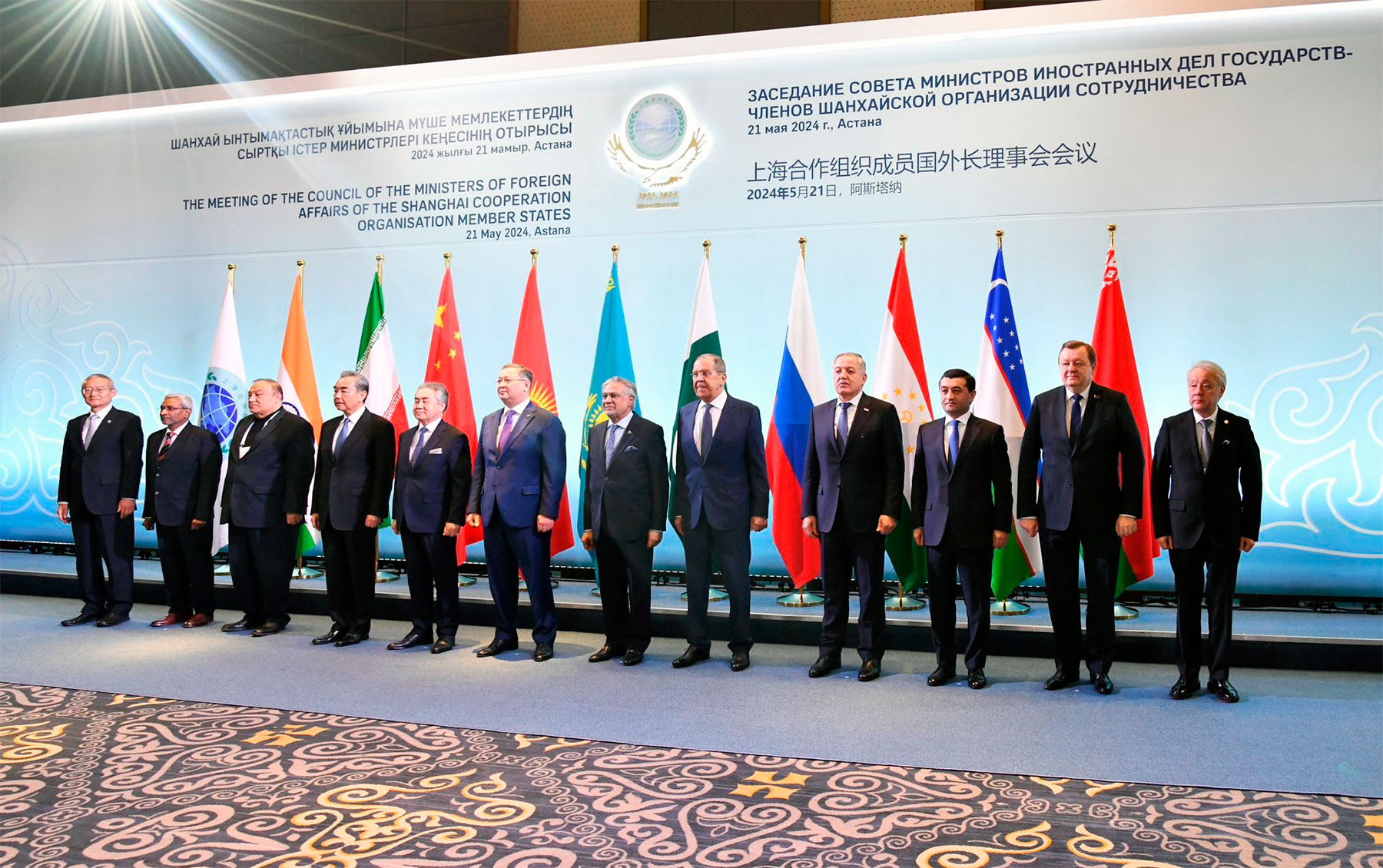
How SCO Contributes to Security in Eurasia
The institutional foundations of the Shanghai Cooperation Organization are deeply rooted in its original mandate to counter the “three evils,” namely terrorism, separatism, and extremism. The Regional Anti-Terrorist Structure (RATS), the organization’s most developed institutional body, embodies this security centric orientation through its emphasis on intelligence sharing, operational coordination, and collective risk management. This security driven architecture has far reached implications for how the SCO functions as a regional institution. It consistently prioritizes short term stability over structural reforms that might generate economic uncertainty or political exposure. Its consensus-based decision-making procedures and strong sovereignty norms cultivate an institutional culture of caution, which limits transparency and predictability, both of which are essential for deeper forms of economic integration. At the same time, security cooperation remains the only domain in which all major powers within the SCO such as China, Russia, and India can engage without compromising their strategic autonomy or national interests. For Russia in particular, this architecture is especially valuable. In a period of shifting regional alignments, the SCO provides Moscow with a reliable multilateral platform to maintain influence in Central Asia, sustain political dialogue with both China and India, and push back against narratives suggesting a decline in Russia’s regional role.
Economic Expansion Without Economic Integration
Despite these structural constraints, the SCO has steadily broadened its economic agenda. Recent summits have highlighted digital trade standards, energy cooperation, cross border transport corridors, and discussions on the creation of an SCO Development Bank. However, this gradual expansion reflects coordination rather than genuine integration. The organization lacks supranational economic institutions, and its member states follow markedly different development models and geopolitical priorities. Large-scale infrastructure initiatives, such as the China–Kyrgyzstan–Uzbekistan railway, the Pakistan–China Economic Corridor’s proposed links to Central Asia, and the modernization of the Khorgos dry port on the China–Kazakhstan border, rely primarily on bilateral or subregional arrangements rather than SCO-wide mechanisms. India’s cautious engagement is evident in its limited support for BRI-related corridors and its preference for connectivity alternatives such as the International North South Transport Corridor, while China continues to advance BRI driven bilateralism through agreements like the China Uzbekistan energy cooperation framework or targeted investment packages in Tajikistan. For Russia, this dynamic is inherently double edged. The absence of a unified market prevents China from institutionalizing economic dominance within the SCO, yet Beijing’s expanding financial presence, from major lending commitments to Kyrgyzstan’s infrastructure sector to energy and logistics projects in Kazakhstan, increasingly challenges Moscow’s own economic outreach in Eurasia. Consequently, the SCO’s economic pillar remains deliberately incremental, providing a platform for members to coordinate positions and signal political alignment without taking on binding economic obligations.

Structural Ambiguity: Tension or Managed Complementarity?
The relationship between security and economic agendas within the SCO is often portrayed as contradictory, yet the organization demonstrates that the two can be contextually complementary. Security cooperation strengthens border stability and mitigates risks along key corridors, creating a permissive environment for selective economic initiatives. Joint counterterrorism exercises such as “Peace Mission,” coordinated patrols along the China-Kazakhstan border, and intelligence exchanges through the Regional Anti-Terrorist Structure have all contributed to more predictable operating environments for infrastructure and trade projects. At the same time, heightened security measures, including restrictive visa regimes in Central Asia, political sensitivities surrounding Chinese investment, and stringent data control regulations in China and Russia, can impede trade flows, cross-border mobility, and digital connectivity. This interplay produces a structural ambiguity that functions not as a weakness but as a workable equilibrium. China views the SCO as a diplomatic complement to the Belt and Road Initiative, using it to support projects like the China–Kyrgyzstan–Uzbekistan railway. Russia relies on the organization as a political coordination platform that prevents the emergence of overly institutionalized economic structures that could overshadow the Eurasian Economic Union. India uses its membership to maintain strategic presence in Eurasia without committing to BRI corridors it has chosen not to endorse. Central Asian states, meanwhile, use the SCO to diversify partnerships, seeking investment and security guarantees from both China and Russia while carefully protecting sovereignty, as seen in Uzbekistan’s and Kazakhstan’s selective engagement with connectivity and energy projects. The SCO’s capacity to absorb and balance these divergent expectations is precisely what underpins its durability.
Enlargement and Its Consequences
The accession of Iran in 2023 and Belarus in 2024, together with growing interest from several Gulf states in obtaining observer or dialogue partner status, significantly expands the SCO’s geopolitical footprint while introducing new strategic sensitivities. For Russia, this enlargement carries both notable advantages and potential risks. On the one hand, it broadens Moscow’s diplomatic network at a time of heightened Western sanctions, strengthens its narrative of an emerging Eurasian multipolarity, and enhances the organization’s political weight across adjacent regions. On the other hand, a larger and more diverse membership complicates consensus-based decision making, a challenge already evident in differing approaches to Afghanistan and sanctions regimes. Iran’s strategic posture, including its security concerns in the Gulf and its economic ties with China, does not always align with the priorities of Central Asian states that prefer neutrality and balanced diplomacy. At the same time, China’s economic influence is likely to deepen as new members increasingly turn to Beijing for investment in energy, infrastructure, and digital connectivity, potentially shifting the balance of economic leadership within the organization. The overall outcome is likely to be greater political significance but weaker institutional cohesion, an evolution that reflects the SCO’s long-standing tendency to manage rather than resolve internal complexity.
Policy Implications: What the SCO Can Realistically Deliver
The SCO’s future contributions will continue to center on regional stability, supported by counterterrorism cooperation, intelligence exchanges, and sustained political dialogue among its members. Economic coordination is likely to progress only incrementally, particularly in domains such as digital governance, transport facilitation, renewable energy, and customs simplification, rather than through any movement toward a unified market or harmonized economic framework. The organization will also remain an important arena for Russia–China strategic balancing, allowing Moscow to preserve regional relevance and constrain the full institutionalization of China’s economic leadership in Eurasia. At the same time, consensus-based decision making and divergent national priorities limit the SCO’s prospects for deeper institutionalization, making its evolution into either a formal security alliance or an integrated economic bloc unlikely. Ultimately, the SCO’s enduring value lies not in transforming Eurasia but in managing its complexities and providing a predictable platform for coordination in a region marked by persistent geopolitical uncertainty.
Conclusion: The SCO’s Future Lies in Managing, Not Resolving, Its Dual Agenda
The SCO embodies a persistent tension between security imperatives and development ambitions, but this tension is not a weakness. Rather, it is the structural condition that enables the organization to function across a vast and politically diverse Eurasian landscape. The coexistence of these competing priorities reflects the realities of a region where states seek stability and economic opportunity without relinquishing sovereignty or aligning too closely with any single great power. For Russia and other member states, the SCO will continue to serve as a stabilizing mechanism that manages the intersection of security and development, providing a platform for political coordination even when deeper institutional convergence is neither feasible nor desired. Its future is likely to be shaped by pragmatic, issue specific cooperation, flexible policy experimentation, and the organization’s ability to adjust to the shifting dynamics of Eurasian multipolarity, including changing China Russia relations, evolving Central Asian strategies, and the interests of newly acceding members such as Iran and Belarus. In this sense, the SCO’s dual agenda is not an obstacle to overcome but a strategic equilibrium to maintain, allowing the organization to balance divergent expectations while preserving its core role as a forum for dialogue, stability, and managed regional coexistence.
(no votes) |
(0 votes) |
Developing a new, understandable language of “sustainable security” in Eurasia, thanks to which everyone will be able to contribute to solving and anticipating common problems in their own way, is necessary
The Proof of the Pudding: Outcomes of the 25th SCO Summit for India and PakistanThe summit took place in the right place at the right time
Eurasian Security Architecture: Origins, Core Principles, and Prospects for EvolutionValdai Discussion Club Report


