
Post-Soviet Referendums: Seeking Internal Stability
In
Login if you are already registered

Ph.D., Director General of Center for Study of Integration Prospects, Editor-in-Chief, RuBaltic.Ru
On September 26, 2016, Azerbaijan held a referendum to address amendments to the Constitution. The results were not at all surprising, with the overwhelming majority of the population backing the amendments to extend the presidential term to seven years from the current five, introduce the positions of vice-presidents, and reduce the age limit for presidential and parliamentary candidates.
Naturally, no fundamental change in the country’s political processes will follow the vote. Of all the possible consequences of the referendum that have been discussed, the most likely is a decision on holding an early presidential election in Azerbaijan in order to avoid having the election campaign in the potentially challenging year 2018. Either that, or the current government will see reshuffles. The referendum was first and foremost a move to correct an already established and operational system, rather than a response to the internal crisis or attempt to rectify functional contradictions.
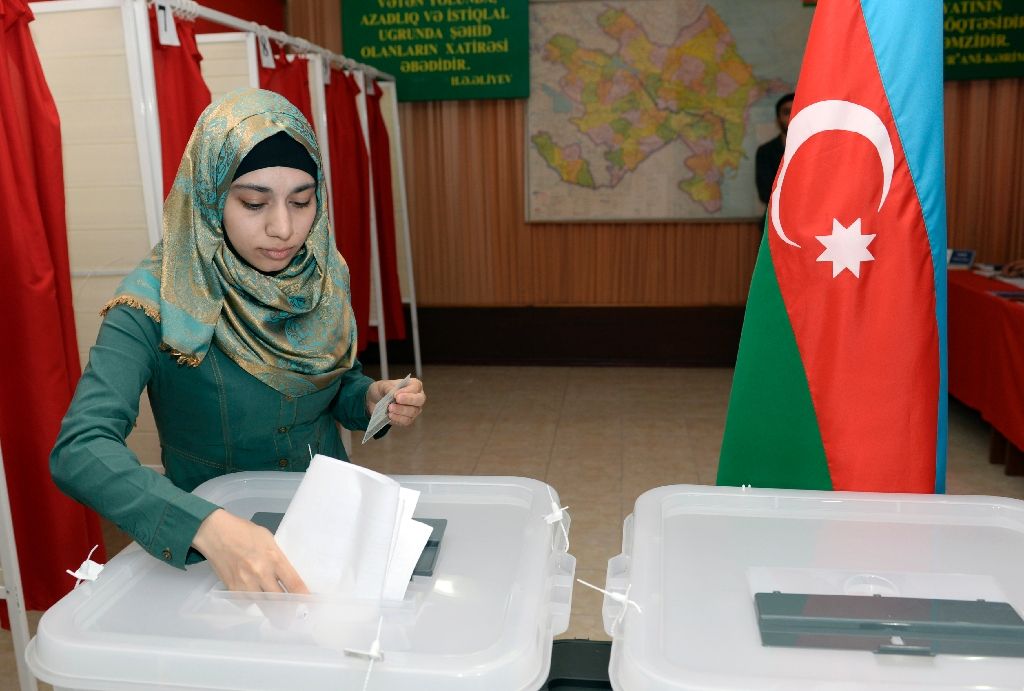
AFP Photo/Tofik Babayev
Interestingly, this was not the only referendum to “adjust the political toolkit” over the past 12 months in the Eurasian space.
In Armenia, a referendum was successfully held in December 2015 to extend the presidential term to seven years from five; however, the political centre of gravity was shifted to the premier, who is now Commander-in-Chief. The Armenian president will from now on be elected by deputies and electoral delegates representing the local authorities, rather than by universal vote.
In Tajikistan, a referendum was held in May 2016 and was a lot like the one that was conducted in Azerbaijan. Voters allowed the incumbent president, Emomali Rakhmonov, to be re-elected without any limitations and approved the reduction in the age limit for presidential candidates to 30, as well as a ban on the establishment of nationalist and religious parties in the country.
In Kyrgyzstan, another important post-Soviet vote will be held in November 2016, focusing on the redistribution of powers in the structure of the state administration. As in Armenia, the population of Kyrgyzstan was offered the opportunity to give more powers to the prime minister, for instance, allowing him/her to independently make personnel decisions at the level of heads of local administrations and members of the government. For Kyrgyzstan, these are quite insignificant changes to the constitution, as there have been many attempts over the past few years to find a balance between the branches of government.
Just like the referendums held in other post-Soviet countries, the vote in Azerbaijan is an attempt to improve the stability of the domestic political system amid the important economic and geopolitical processes that are taking place in the region, as well as to proactively set the stage for political succession. Each country has its own vision as to the source of this political stability and the institutionalization of the transfer of power: some find it in the consolidation of the president, while others believe it lies in the redistribution of functions between various authorities. There is no single recipe, and one can only look at various paths of political evolution, analysing the respective pros and cons.
The Eurasian space is gradually entering a new phase. It is no wonder that the political systems of the countries in the region are being upgraded in accordance with this new reality.
(no votes) |
(0 votes) |


