
Lithuania Starts Nuclear Information War against Belarus
In
Login if you are already registered

Ph.D., Director General of Center for Study of Integration Prospects, Editor-in-Chief, RuBaltic.Ru
Alarming news spread this week on social networks and in the media: back in early July, 2106 “a piece of equipment weighing 330 tonnes” crashed at the nuclear power plant (NPP) being built in the city of Ostrovets in Belarus. Several publications later, “a piece of equipment” was already transformed into a “nuclear reactor.” The main heralds of the environmental disaster were not so much Belarusian opposition media as Lithuanian pro-government ones. President of neighbouring Lithuania Dalia Grybauskaitė responded to these reports almost immediately, making statements to the effect that the Belarusian NPP was dangerous and the construction should be stopped. Later it turned out the head of the Baltic republic had “jumped the gun” and clearly demonstrated her wishful thinking.
Rosatom (head contractor of the NPP) made a statement that “the nuclear reactor’s case is outside the reactor compartment. There are no obstacles to installing it at its intended site.” That is, no matter how much one would want to drop the reactor, it was technically impossible, since the reactor had not even been installed yet. Then Belarus’ Ministry of Energy stated that an irregularity had, indeed, taken place but that it had not occured in the reactor compartment, and nothing at all had ever been dropped.
REUTERS/Vasily Fedosenko
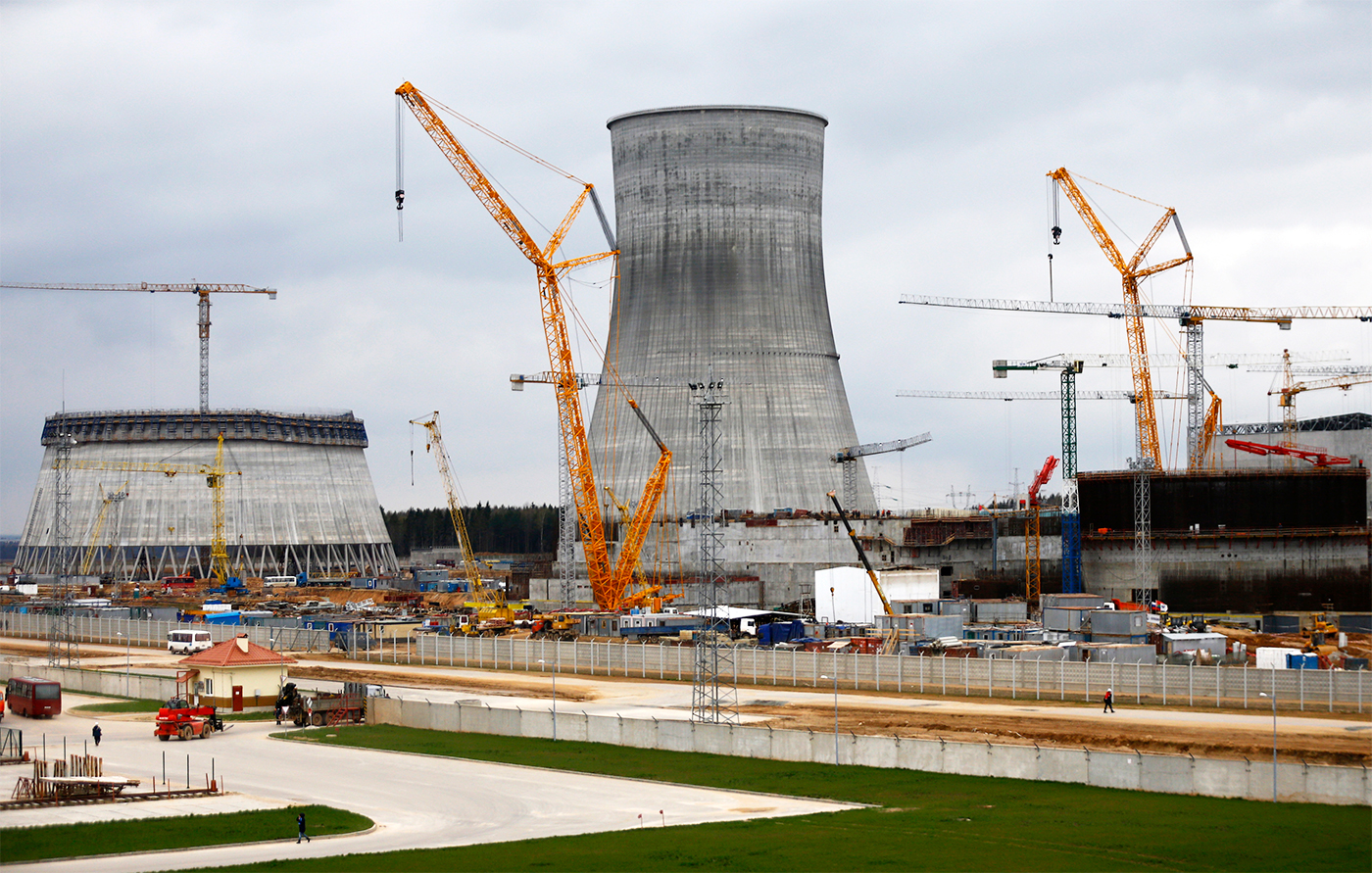
The construction site of the Belarusian nuclear power plant, which will have two power-generating units, is seen near the town of Ostrovets, Belarus April 19, 2016
In a word, information attacks on the Ostrovets NPP from the Lithuanian leadership and Belarusian opposition seem to borrow their script from the old joke: “Is it true that Abramowitz won a million in the lottery? Absolutely true. Except it was not Abramowitz, it was Rabinowitz, it was not the lottery, it was cards, it was not a million, it was a hundred roubles, and he did not win, he lost.” This script is now being run once a month, on schedule. In May, Lithuanian media spread information about a “breakdown at the Belorusian NPP.” It was not confirmed. In June, they reported some utterly mysterious incident that was “much worse than the last time.” This story in July is number three. And each time, Lithuania’s State Security Department and Ministry for Foreign Affairs become hectically active and the Ministry for Foreign Affairs delivers a note to the Ambassador of Belarus even before the situation becomes clear. Lithuanian politicians of all levels also remember to speak regularly about the Ostrovets project being “secret” even though, back in April, Yukiya Amano, head of the IAEA, stated that the NPP under construction had a high safety level. This week, against the background of the overblown scandal, Belarus received experts from the IAEA and seven more of such missions will visit the NPP before 2018.
Of course, the Ostrovets NPP is being constructed close to Lithuania, but such hectic activity on the part of official Vilnius still appears over the top. Yet not accidental. All these actions fit perfectly with Lithuania’s energy strategy. Starting with closing down the Soviet Ignalina NPP on 31 December 2009, Vilnius has been attempting to limit the presence of Russia’s energy in the country and in the region as a whole, at any cost. Lithuania is constructing an LNG-terminal in Klaipeda, although its economic expedience is doubtful; it is building interlinks with Poland and Sweden’s power grids, trying to leave the united energy system of Belarus, Russia, Estonia, Latvia and Lithuania; it is fighting against Nord Stream-2, which could bring it money. This policy’s crowning glory is the failed Visaginas NPP; over six years, the project never moved beyond making political statements and searching for a strategic investor. Vilnius dreamed of this NPP drawing a thick line under the history of Russia’s presence in the region and laying the foundations for Lithuania’s energy independence. In reality, Rosatom, in full compliance with the plans and safety regulations, is constructing another NPP in Ostrovets, which could supply cheap power not only to Belarus but also to neighbouring states. Could Grybauskaitė and Co keep silent under such circumstances?
defi.lt
Lithuania sees the Ostrovets NPP primarily as a geopolitical rather than an environmental threat. Had this not been the case, why isn’t Vilnius worried about the critical safety situation at Ukrainian NPPs? Accordingly, the consequences of the Lithuanian struggle against the Ostrovets NPP could be geopolitical, rather than environmental. Of course, one could envision a positive scenario when the attacks on the power plant cease simultaneously with the parliamentary elections in Belarus and Lithuania this autumn. Implementation of the Ostrovets project will be depoliticised as much as possible and, after Grybauskaitė steps down as President, Lithuania and other Baltic states could become interested in the power produced at the Ostrovets NPP (thus far, the Lithuanian leadership is seeking to organise a “regional boycott” of the project).
Yet the negative scenario is more likely. Lithuania will increasingly politicise the Belorusian nuclear plant construction. Vilnius will traditionally try to deliver a blow against Russia by calling the construction unsafe and Rosatom incompetent, and dubbing the project another of the “Kremlin’s tentacles” squeezing Europe. In the very near future, we might expect “expert reports” explaining that the Ostrovets NPP is intended to play a role in the “impending Russian annexation of Belarus.” There could be options, but the main goal will be to blame Moscow for its attempts to use the NPP to embroil Belarus in confrontation with the West, although the picture we see so far is the direct opposite. But, in its attempts to “teach a lesson” to Russia, Lithuania will inevitably tread on Belarus’ toes. The thing is that, today, the Ostrovets NPP is one of Minsk’s top priority economic projects. And Minsk is unlikely to look kindly at the attempts to interfere with its implementation. Moreover, the Belarus leadership has enough instruments to retaliate against Vilnius, up to and including re-routing its transit shipments from Klaipeda to Russian ports.
Lithuanian attacks on the Ostrovets NPP could result in failure of the “engagement policy” the European Union has been attempting to pursue over recent years toward Belarus; these attacks could also lead to Lithuania losing another regional partner (following Poland and Russia) and incurring economic losses owing to Minsk’s retaliation. The Baltic politicians will hardly succeed in pulling the plug on the Ostrovets project. As paradoxical as it sounds, the Republic of Lithuania itself might suffer the greatest losses in this story.
(no votes) |
(0 votes) |


