
Georgia Reconsidering Russia
In
Login if you are already registered

Ph.D., Director General of Center for Study of Integration Prospects, Editor-in-Chief, RuBaltic.Ru
The end of October was marked by the second round of parliamentary elections in Georgia. The governing party Georgian Dream is celebrating the victory. And there is a reason to celebrate: the party not only won the legislative polls, but also preserved the country control levers. The current situation in Georgia implies that the second is the automatic result of the first.
Parliamentary election campaign 2016 was quite intense and competitive. And the discussions about Mikhail Saakashvili’s possible return to office, him currently being on the wanted list in Georgia, spiced the whole situation. Not long before the first round of the elections Georgian information space was filled with proofs of the country destabilization being prepared by M. Saakakshvili with public buildings takeover resulting from the United National Movement (ENM) election failure. No man ever steps in the same river twice - and ENM actually failed the elections, though no forcible attempts to «change» the results followed the elections, the gap between the two parties was too obvious. After the two rounds of elections the governing party did win the elections getting the constitutional parliamentary majority as well. After the 2012 elections Georgian Dream had 85 seats in parliament while ENM had 65, this year resulting 115 against 27. Thus, the governing party almost repeated the 2008 success of the nationals with ENM getting 119 parliamentary seats.
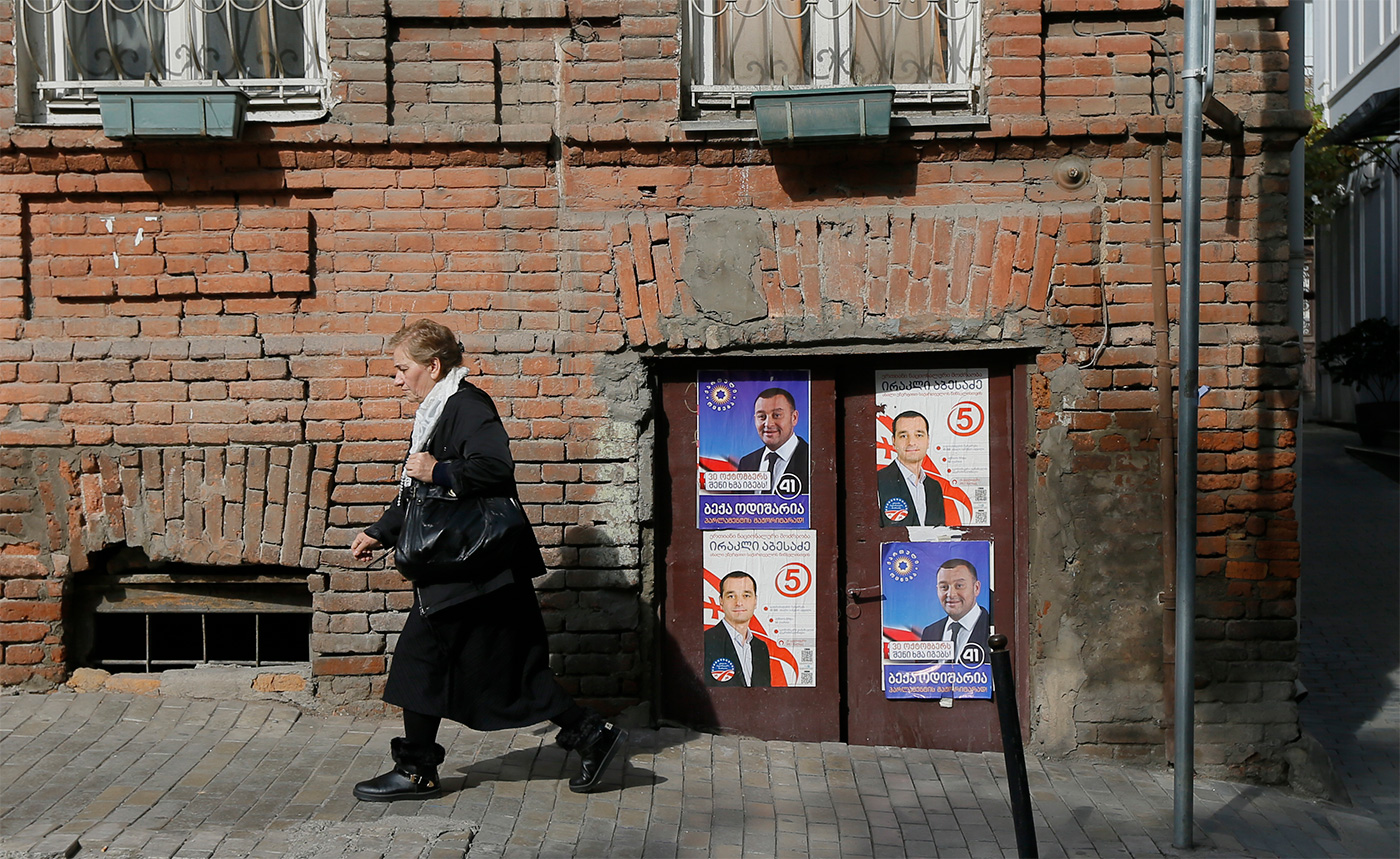
The election results prove the fact that in the last decade a two-party political system did form in Georgia. Georgian Dream and the United National Movement stay in harsh opposition, although they manage to represent the point of view of the politically active majority in Georgia. The two-party election results of 2012 could be treated as a political coincidence, given that the current results make it seem more like a tendency.
It should be noted that another party, Alliance of Patriots of Georgia, has got six mandates in Georgian parliament. This political power is in favor of EU Association Agreement ratification being suspended. Its influence is very limited, though the national-level parliamentary presence of anti-western and anti-turkish minority alongside with the mainstream Dream is quite notable. Such elections results are no random coincidence of the electorate views, weather, political technologies, or anything of the kind. The Georgian society has been reconsidering its attitude towards Russia for the last several years. And it appears more obvious in the survey results on geopolitical priorities. For example, according to EDB Integration Barometer-2016, Georgia has not been in the priority country list with EU-focused geopolitical vector since 2015. Moreover, Georgia had positive dynamics in mutual attraction value change towards Russia between 2012-2013 and 2015-2016, a similar situation being noticed in the western surveys. National Democratic Institute (NDI) survey, spring 2016, shows that equal numbers of Georgians (13%) see Russia and EU as guarantor of Georgia’s security, and about 20% of the respondents are in favor of the country being a member of the Eurasian Economic Union (only 11% supported this point of view in 2013 after the Eastern Partnership Vilnius Summit).
Georgian society and elite are definitely not turning to the East. Tbilisi downtown is decorated with EU and NATO flags. And no one is going to withdraw the Abkhazia and South Ossetia issues from the agenda: on the one hand, this is an issue of uncontrolled territories for Georgia, on the other hand, it is an issue of pointless fears that Moscow can call off Abkhazia and South Ossetia republics recognition of independence, dating back to Tskhinvali events after the first Georgian Dream victory. The warming up in the attitude towards Russia cannot stay unnoticed in Moscow - all the possible measures have to be taken. The options might be: no-visa entry for Georgian citizens to Russia being not just a symbolic means, but also intensifying humanitarian connections between the neighboring countries. It is possible that personal acquaintance of the Georgian youth with Russia and their participation in educational projects could ensure advancement of Russia in Georgia.
(no votes) |
(0 votes) |


