
Election Day: Renewed Parliament in Belarus
In
Login if you are already registered
Ph.D., Director General of Center for Study of Integration Prospects, Editor-in-Chief, RuBaltic.Ru
On the face of it, the election to the House of Representatives of the National Assembly, held on September 11, 2016 in Belarus, seemed to be a purely domestic political issue. Only Belarusian political scientists, except for three members of the Russian-Belarusian expert club, including the author of this column, were enlisted to analyze the voting results. However, the election intrigue had a clear foreign policy perspective: will the opposition get seats in the new parliament, and how will the West react to the voting results?
Belarusian colleagues did not expect any fundamental change on that score. Even during the election campaign, the local opposition clearly demonstrated that it preferred to get busy with scandalous behavior like holding itself out as a “bullet for president,” putting on gas masks, flying flags of foreign countries, or calling for drugs legalization, rather than engage in real political struggle. The western assessment of the Belarusian elections traditionally reflects the OSCE opinion on this election campaign. On August 31, 2016 the Organization published an interim report on the parliamentary elections in the Republic of Belarus. While acknowledging certain progress of the country towards democratization, the report noted its insufficiency for Europeans, and emphasized the necessity to develop the party system, opposition and opposition media.
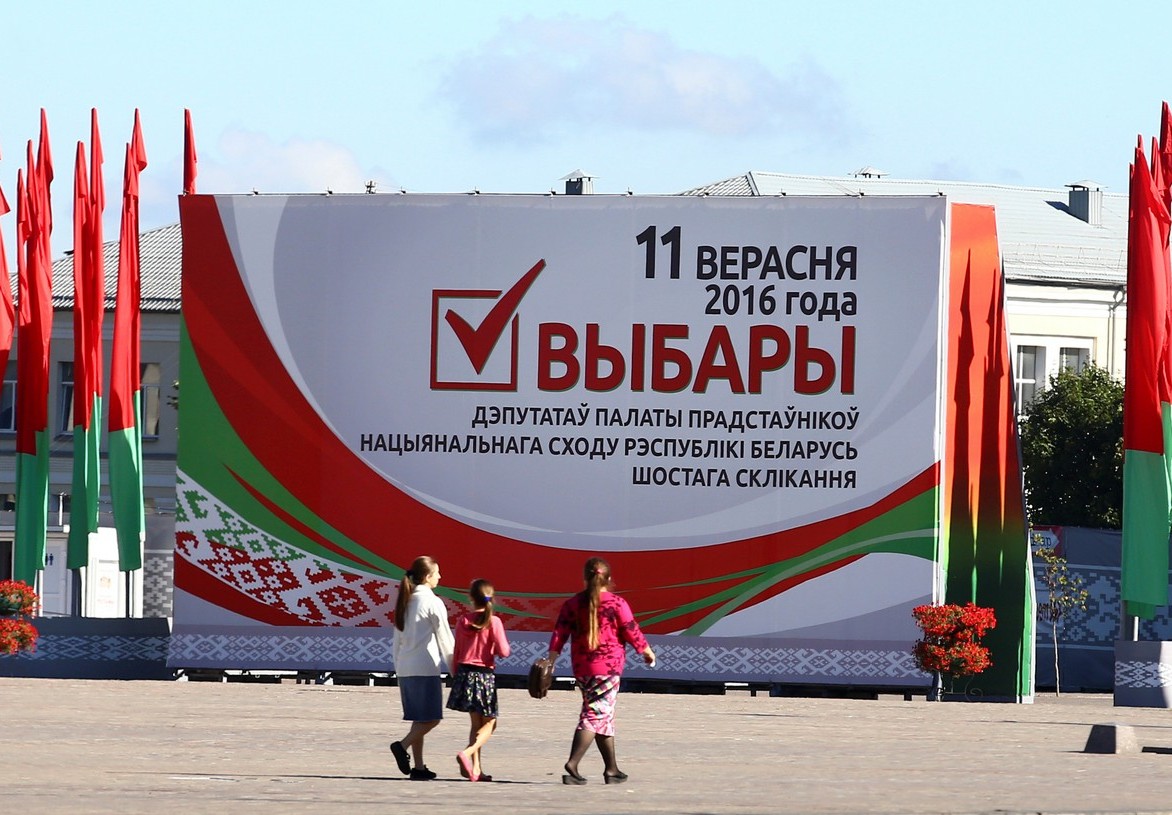
REUTERS/Vasily Fedosenko
Overall, the Election Day was held in a normal way, undisturbed by open provocations. Incidentally, some local fringes desperately looked forward to such provocations, and even predicted on Facebook nearly an imposition of the martial law because of the riots that had been allegedly prepared by the pro-Western opposition, but organized by Moscow. Quite a dubious logic (if there is any), but one can come up with even wilder things in search of sensation.
On the way to the Information Centre on the 2016 parliamentary elections, opened on the Election Day at the Palace of the Republic in Minsk, we managed to visit an ordinary polling station, located in the motor pool territory. There was hardly any difference from what is likely to be observed in Russia on September 18: voting booths, a lot of observers, a polite spokesperson of the divisional election committee. However, we did notice one peculiarity, namely a van with products at reduced prices parked next to the polling station – apparently, to create a holiday atmosphere at the elections and attract voters.
At the Information Center, Chairman of the Central Election Commission Lidiya Yarmoshyna appeared at regular intervals to brief journalists on election process, answer their questions and contact colleagues from the regions: violations were discussed under the eye of journalists upon receipt of complaints.
In between press conferences, experts and media representatives discussed the present and future of the Belarusian parliamentary system. Moreover, the discussion was not reduced to standard statements, which is common for election days. The discussion was not an idle talk, and did not reduce itself to making everything the way others did. At last, as Belarusian experts rightly reminded, the majority system functions quite effectively in the UK – the birthplace of modern parliamentarism. In contrast, the abundance of parties in the Baltic States failed to ensure their stability and democracy of political processes. By the way, the parliamentary election campaign in Lithuania is now in full swing, and party conflicts in the country have already disrupted the work of the government. Social Democrats enjoy the majority in the ruling coalition, while the President is close to their main opponents, namely the Conservatives. This is precisely why, during the pre-election period, the head of state impeaches a too regular basis the head of the cabinet, or other members of the government for taking bribes. As a result, the normal functioning of government agencies is virtually paralyzed.

Thus, well-developed parties are not at all a panacea for an effective functioning of democracy, as the OSCE insists in its recommendations to Minsk. Belarus is well aware of that and regards the issue as a purely practical matter. Proponents of the party system progress in Belarus point out the necessity of building institutions to ensure political continuity in the country’s development. The voting on September 11, 2016 established as a fact the influence growth of parties in the Belarusian parliament (the number of party deputies in the new parliament doubled and became 16 against 8 in the previous convocation). Perhaps, this is the main outcome of the elections, rather than electing to the House of two opposition deputies, which was blown out of proportion by the media.
Belarus development course remains the same: no matter how hard social networks tried to make a big deal out of protests actions of few in number street radicals, they had no impact on the election. It is no accident that the Election Day in Minsk ended by voters’ spontaneous visit to the Eternal Flame at the Victory Square. No matter the elections, certain things should retain their enduring value for the country.
(no votes) |
(0 votes) |


