Brussels Intends to Tackle European Integration’s “F-students”
In
Login if you are already registered

Ph.D., Director General of Center for Study of Integration Prospects, Editor-in-Chief, RuBaltic.Ru
The European Union intends to resuscitate its Eastern Partnership. At the seventh meeting of the Ministers for Foreign Affairs and states members of the program the diplomats discussed the principal directions of Brussels’ relations with the six post-Soviet states.
The Eastern Partnership Riga summit which was held a year ago to the day, in essence stated that the initiative was dead in the water, at least in its original form, when European mechanisms and values had been posited as universal tools for state modernization and had been offered to Belarus, Ukraine, Moldova, and the trans-Caucasian countries as a standard package. However, the European Commission’s bureaucratic logic does not allow for the project’s inglorious death: budgets must be used up, and the EU’s external ties must be developed. That is why back in Riga, an announcement was made that the next Eastern Partnership summit would take place in 2017. Why are more meetings necessary, will the program even continue to exist in its previous incarnation? These were questions of secondary importance. The answer to them was searched for on May 23 a year later when the Ministers for Foreign Affairs of the EU countries met with their counterparts from Armenia, Azerbaijan, Belarus, Georgia, Moldova, and Ukraine.
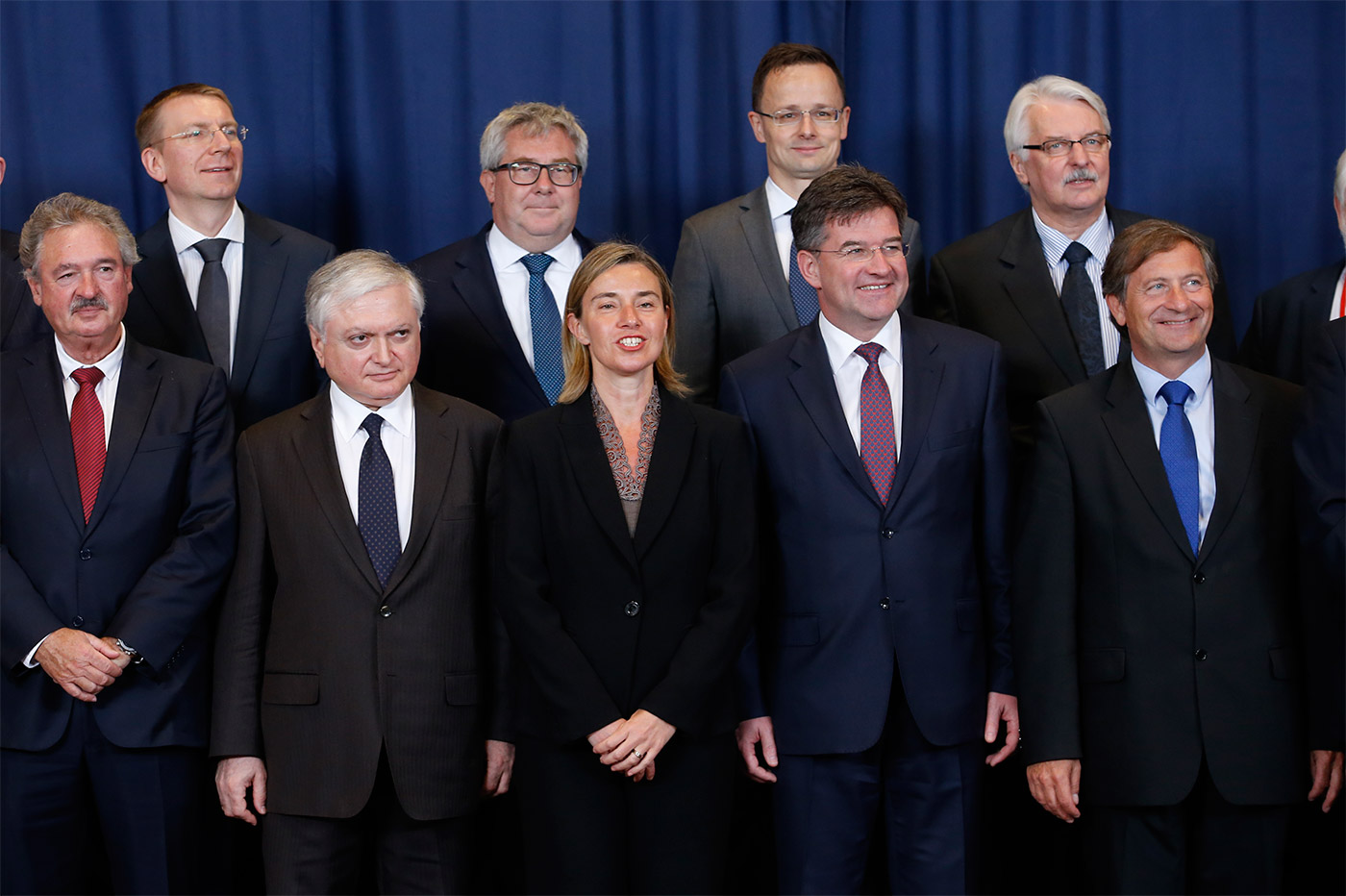
Фото: EPA/OLIVIER HOSLET/Vostock Photo
Currently, the refugee crisis has evidently eclipsed the problems of relations with eastern partners and even the Ukrainian crisis, and that is why at the meeting, Federica Mogherini, the HighRepresentative of the European Union for Foreign Affairs,hastenedto make every assurance that it is of crucial importance for Brussels to focus “on the Eastern route and on the Southern route at the same time, giving the same level of importance to both.” Maintaining focus on the East took the shape of EU’s readiness to transform the Eastern Partnership in order to save it.
Judging by the meeting, the revival of the initiative means differentiating Brussels’ approach to different partners depending on their interest in European integration. It was probably Belarus who, over the past few years, clamored the most for such a reform of the Eastern Partnership, since it was excluded from several work formats within the program due to its “modest ambitions” in the European direction. Now the “outsider” of the post-Soviet club of European integration fans became the chief beneficiary of the upcoming summit. In 2013, Ukraine with its Association Agreement was the star of the Eastern Partnership meeting; in 2015, the Ukrainian crisis and its influence on the region were the highlight of the summit, and in 2017, the main event may turn out to be the signing of a framework agreement between Minsk and Brussels. At the May meeting, Vladimir Makei, the Minister for Foreign Affairs of the Republic of Belarus, suggested starting consultations on the issue.
Azerbaijan and Armenia form another group of states members of the program. Despite the differences and contradictions between these republics, they have the same goal within the Eastern Partnership, and it is to sign a renewed agreement on partnership and cooperation with the EU. Azerbaijan presented its draft document back at the Riga summit, Armenia initiated consultations on a similar agreement in December 2015. In essence, the new legislative foundation of the relations with Brussels should replace the association agreement which Yerevan and Baku had rejected.
The third group of states members of the Eastern Partnership includes Brussels erstwhile “pets” in the post-Soviet space: Ukraine, Georgia, and Moldova. As paradoxical as it sounds, the EU’s principal task regarding these republics is its least ambitious this time around, and that task is to demonstrate solidarity and the kinship of ideas. Over the recent years, these countries turned from “pets” into the “dead weight” European diplomacy has to carry. Kiev ignores the Minsk Protocol which the EU supports, and compromises “European choice” with Ukrainian domestic chaos. Moldova is fairly close to Kiev, since its non-European level of corruption provoked street protests which lasted for several months, and a governmental crisis. Ultimately, today Brussels’ principal task in that line is to put a good face on a sorry business. Kiev and Tbilisi both still await a visa free regime with the EU, yet, as the Ministers for Foreign Affairs of France and Germany made it clear prior to the May meeting of the Eastern Partnership, that issue is being postponed for an unspecified period of time.
One interesting thing about preparations for the 2017 Eastern Partnership summit is that the organizers have not yet decided on the venue. It might seem like a technical question, but under current circumstances, it turns political. Malta holds the EU Presidency in the first half of 2017. Yet holding a meeting on the EU’s eastern policies there would be odd to say the least. Probably, pictures from the beautiful beaches of Malta instagrammed and tweeted by Ukraine’s political elite would demonstrate to their voters the success of Kiev’s “European choice”, but on the whole, it is difficult to explain where the interests of Malta, Brussels, Ukraine, Moldova, or Armenia overlap. Tallinn would be the most logical venue for another Eastern Partnership summit. Estonia’s presidency in the EU comes shortly after Malta’s, it is scheduled for 2018. Tallinn probably would not be terribly excited to be granted the privilege of holding the summit of a problematic program. But another thing is of greater importance here: Brussels’ bureaucrats need to demonstrate the program’s active work, and a summit delayed for a year would only emphasize the crisis of the EU’s eastern policies.
(no votes) |
(0 votes) |