
Has a Transatlantic Split Occurred?
In
Login if you are already registered

Ph.D. in Political Science, Director General of the Russian International Affairs Council, RIAC member
A noticeable and, for many, unexpected outcome of 2025 was the difficulties that emerged in US-EU relations. Washington has made a sharp turn in its foreign policy across a number of areas. This shift has impacted cooperation with European allies. These changes stand in particular contrast to the Biden presidency, when the US and EU achieved unprecedented solidarity, including on the issue of containing Russia. But can we really speak of a transatlantic schism? After all, the US and the EU are linked by formal relations within NATO, a vast cultural legacy of alliance relations, and close economic ties. Are we witnessing a fluctuation, albeit acute, but reversible? Or are we witnessing a fundamentally new trend that will only manifest itself in the future?
It is too early to talk about an irreversible and complete split between the US and the EU. NATO remains a rock-solid security structure. Moreover, Washington’s European allies are now willing to meet the demands that Donald Trump set during his first presidential term—to spend more on defence. Military action in Ukraine continues, as do previously imposed US sanctions. Moreover, Washington’s political course could be reformatted by a new administration if the Democratic candidate wins the 2028 elections. It seems that European allies will be hoping for a change of administration in the near future.
A noticeable and, for many, unexpected outcome of 2025 was the difficulties that emerged in US-EU relations. Washington has made a sharp turn in its foreign policy across a number of areas. This shift has impacted cooperation with European allies. These changes stand in particular contrast to the Biden presidency, when the US and EU achieved unprecedented solidarity, including on the issue of containing Russia. But can we really speak of a transatlantic schism? After all, the US and the EU are linked by formal relations within NATO, a vast cultural legacy of alliance relations, and close economic ties. Are we witnessing a fluctuation, albeit acute, but reversible? Or are we witnessing a fundamentally new trend that will only manifest itself in the future?
New Sanctions as a Political Signal
The relationship between the US and its NATO allies in Europe have experienced multiple crises throughout their history. For example, in 1956, the Suez Crisis erupted following the nationalisation of the Suez Canal by the Egyptian government and a subsequent military intervention by Britain, France, and Israel to regain control. Soviet leader Nikita Khrushchev threatened a nuclear strike on the invading countries. But the United States also weighed in. Washington opposed the military intervention, threatened its allies with economic sanctions, and even implemented some restrictive measures. During the Cold War, Western European countries actively developed economic ties with the USSR. The United States was unable to impede pipeline projects that transformed Moscow into a vital energy supplier for Germany, Italy, and a number of other major economies. European allies long ignored the crisis in US-Iran relations following the 1979 Islamic Revolution. Unlike the United States, they continued to purchase Iranian oil and invest in Iranian industry. The United States was only able to end this independence in the 2010s under the threat of secondary sanctions and financial penalties. The European Union criticised the US invasion of Iraq in 2003. Germany and France were particularly vocal. Even Moscow adopted a more cautious and balanced policy. Finally, after the Ukraine crisis started in 2014, the EU was hardly in a hurry to escalate sanctions against Russia. Brussels, and especially Berlin, were irritated by the first Trump administration’s attempts to impede the construction of the Nord Stream 2 pipeline project under the Baltic Sea.
Nevertheless, individual crises remained localised. They were absorbed by shared security institutions (NATO), similar ideological positions in foreign policy, and close economic ties. After the launch of Russia’s Special Military Operation in 2022, Atlantic solidarity between the US and European allies increased significantly against the backdrop of containing Russia and aid to Ukraine. The synchronisation of sanctions, military supplies, and security cooperation reached a new level. NATO expanded again. The EU moderated its criticism of the US over Iran and subsequently reinstated sanctions against Tehran. Closer cooperation in technology and the search for a common platform to contain China emerged.
The rise of Donald Trump has fundamentally eroded transatlantic solidarity on Ukraine.
The White House’s diplomatic overtures to Moscow were met with a muted and sceptical reception in Brussels. The European Union maintained its adherence to the original paradigm of the conflict: that Russia’s position is illegitimate and must be reversed through comprehensive isolation; that Ukraine requires unwavering support by all available means; and that Kiev’s domestic political shortcomings, however disagreeable, must be temporarily set aside.
The United States, in contrast, pivoted to a new and starkly pragmatic calculus: Russia is too resilient to be forced into capitulation; sanctions, while costly, are strategically ineffective; the war drains resources while allowing Moscow to challenge US interests in other theatres; the immense investment in Ukraine yields no tangible political return, being swallowed by the war effort and corruption; this entanglement must be concluded, ideally on terms favourable to Washington; if Europe chooses to sustain the confrontation with Russia, it must assume the full burden alone; and any future assistance to Kiev must be repaid.
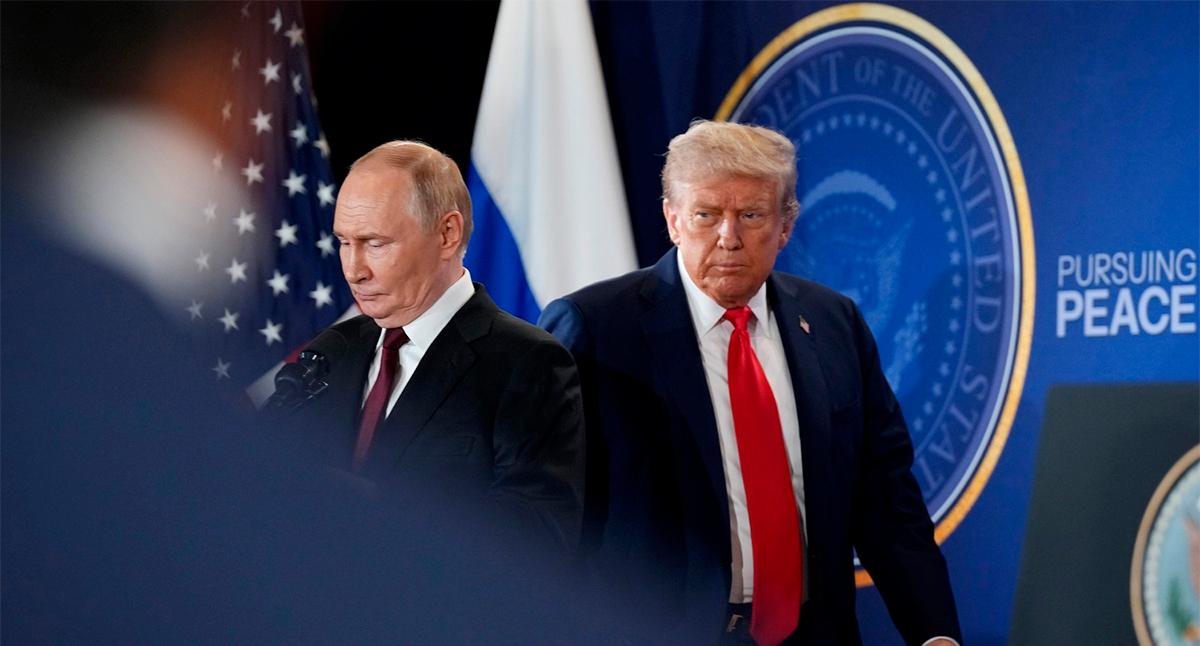
The new American paradigm was unlikely to yield quick results. Russia had already paid a huge price in the Ukrainian conflict. Therefore, it was natural to push for a carefully considered solution rather than a spontaneous ceasefire. Negotiations were up and down, with inevitable disagreements and irritation at the opponent’s intransigence. However, over the course of the year, a shift in the parameters of compromise became evident, in favour of the realities on the ground. The American position shifted away from unrealistic expectations of Ukraine returning to its 1991 borders or NATO membership. The US avoided imposing new sanctions against Russia, with the exception of the blocking restrictions on two major Russian energy companies. The Ukrainian leader was publicly and harshly criticised by the US President and Vice President. The EU, on the contrary, consistently supported the Ukrainian president.
The growing divergences between the US and the EU were not limited to the Ukrainian issue. Donald Trump’s statements about the possible annexation of Greenland caused some consternation among allies. The island is under Danish jurisdiction. Copenhagen is a NATO ally of the United States and one of the most vocal supporters of a common Atlantic policy. Furthermore, the United States has long had military infrastructure on the island, and Danish authorities have historically not interfered with US military activities in Greenland. Trump’s statements were perceived as populist, but they left a bad taste. Analogies with 2014 and Russia’s reunification with Crimea inevitably came to mind, although the historical and political contexts of the two cases differed significantly. Trump’s initiatives have not yet been followed up on, but they have entered the political agenda.
The US Vice President’s public criticism of democracy in individual EU countries also broke the mould. This was voiced at the Munich Security Conference, a key forum for the Euro-Atlantic community. “Europe has departed from its fundamental values—those that connect it to the United States of America,” noted Vice President JD Vance, citing digital censorship, freedom of speech and conscience, and problems with elections. Vance’s ideas were subsequently developed in the US National Security Strategy.
Notably, the Strategy defines the Ukrainian conflict as a rivalry between Europe and Russia, while the United States is seen more as an external power interested in stabilising the continent.
By the end of the year, the topic of digital censorship began to move beyond rhetoric. On December 23, the US State Department announced visa restrictions for five individuals from EU countries. The reason is participation in digital censorship. The sanctions include Thierry Breton, a former European Commissioner and one of the developers of EU legislation in the field of digital services; Imran Ahmed, chief executive of the Centre for Countering Digital Hate; Clare Melford, developer of the Global Disinformation Index; and Josephine Ballon and Anna-Lena von Hodenberg, leaders of HateAid, a German organization. Washington imposed the most lenient sanctions. Trump has not invoked the Emergency Economic Powers Act of 1977 and has not yet declared a state of emergency on this issue or used blocking financial sanctions. It is clear that the US administration also adheres to a very clear ideological line. It may also be criticised in Europe for using sanctions as an element of pressure. French President Emmanuel Macron, in particular, has condemned them.
Finally, the trade war waged by Donald Trump against “the entire world” has become a problem. China can be considered its key target, although Beijing has demonstrated admirable tenacity in defending its interests and ultimately achieved compromise solutions. But the tariffs also hit the EU. Executive Order 14257 imposed a new 10% tariff and an additional 20% tariff on EU countries. Strictly speaking, the EU was not significantly affected. The 20% tariff was subsequently suspended. However, the very fact of a trade war against a close ally completed the picture. Tariff attacks have been a feature of American policy towards allies before. Consider, for example, the tariff war with Japan over competition for the automobile market. But given the current circumstances, they are unlikely to add stability to transatlantic relations.
However, it is too early to talk about an irreversible and complete split between the US and the EU. NATO remains a rock-solid security structure. Moreover, Washington’s European allies are now willing to meet the demands that Donald Trump set during his first presidential term—to spend more on defence. Military action in Ukraine continues, as do previously imposed US sanctions. Moreover, Washington’s political course could be reformatted by a new administration if the Democratic candidate wins the 2028 elections. It seems that European allies will be hoping for a change of administration in the near future.
First published in the Valdai Discussion Club.
(votes: 3, rating: 3.67) |
(3 votes) |
Ukraine will have to pay the price for the hawks’ triumph
Eurasian Security Architecture: Origins, Core Principles, and Prospects for EvolutionValdai Discussion Club Report


