
BRICS Strategic Communication Is on the Rise
(votes: 1, rating: 5) |
(1 vote) |

DSc., Professor and Chief Reseacher, Saint-Petersburg State University
In February 2026, the International Center for Social and Political Studies and Consulting published a report, “Experts on the BRICS Strategic Communication in Global Governance,” stemming from a research project titled “BRICS Strategic Communication in Global Governance,” funded by the Russian Science Foundation. As part a grant project implemented in October and December 2025, two international conferences on BRICS strategic communication (BRICS SC) were held, at which project participants, in addition to many other researchers from around the world, presented their research on the given topic. The first of the conferences was held at the Institute of Philosophy of the Russian Academy of Sciences, and the second (on the role of AI in BRICS SC) at MGIMO University.
The conferences reflected on responses collected from a survey of fifty-seven experts from twenty-five countries. The survey highlights a range of key opportunities and risks concerning BRICS SC by attempting to determine the role of strategic communication in the implementation of BRICS domestic and foreign policy, and possible developments that make take place within the next ten years. Some questions posed in the survey include: which BRICS countries are the most successful in their strategic communication? What factors have a greater influence on BRICS strategic communication, and what strategic communication tools are undervalued in this association and others?
The concern over global security and stability has become a serious concern to hundreds of millions of people today. The Doomsday Clock, which has long been a recognized indicator of the world's existential vulnerability, was reset in 2025 from 90 seconds to 89 seconds before midnight, marking the closest time to a global catastrophe in history. In January 2026, the clock moved another 4 seconds closer to midnight.
The rise in armed conflicts, state fragmentation, escalating geopolitical tensions, heightening global arms race, and trade contradictions are reaching a critical threshold. Strategic communication one of the most important tools of global governance, can both significantly enhance human development and dangerously exacerbate existential risks.
The core element of BRICS strategic communication lies in the concrete actions of the association and its member states. Under this approach, strategic communication becomes an integral part of global governance, ensuring coherence among BRICS actions, discourse, and symbolic representations, as well as their reception by both internal and external audiences. Clarifying the substantive content, key directions, methods, trends, and future prospects of BRICS strategic communication—and assessing its significance for the progressive development of the association, its members, and the wider international community through the expansion of socially oriented global governance—constitutes an important scholarly and practical task.
In February 2026, the International Center for Social and Political Studies and Consulting published a report, “Experts on the BRICS Strategic Communication in Global Governance,” stemming from a research project titled “BRICS Strategic Communication in Global Governance,” funded by the Russian Science Foundation. As part a grant project implemented in October and December 2025, two international conferences on BRICS strategic communication (BRICS SC) were held, at which project participants, in addition to many other researchers from around the world, presented their research on the given topic. The first of the conferences was held at the Institute of Philosophy of the Russian Academy of Sciences, and the second (on the role of AI in BRICS SC) at MGIMO University.
The conferences reflected on responses collected from a survey of fifty-seven experts from twenty-five countries [1]. The survey highlights a range of key opportunities and risks concerning BRICS SC by attempting to determine the role of strategic communication in the implementation of BRICS domestic and foreign policy, and possible developments that make take place within the next ten years. Some questions posed in the survey include: which BRICS countries are the most successful in their strategic communication? What factors have a greater influence on BRICS strategic communication, and what strategic communication tools are undervalued in this association and others?
The concern over global security and stability has become a serious concern to hundreds of millions of people today. The Doomsday Clock, which has long been a recognized indicator of the world's existential vulnerability, was reset in 2025 from 90 seconds to 89 seconds before midnight, marking the closest time to a global catastrophe in history. In January 2026, the clock moved another 4 seconds closer to midnight.
The rise in armed conflicts, state fragmentation, escalating geopolitical tensions, heightening global arms race, and trade contradictions are reaching a critical threshold. Strategic communication one of the most important tools of global governance, can both significantly enhance human development and dangerously exacerbate existential risks.
Strategic Communication in Global Governance

Why Multilateral Diplomacy Is in Crisis
Timely engagement with the theory and practice of strategic communication, guided by the public interest, is essential for effective national development and for the preservation of stability and cooperation in the international system. This importance can be understood through the calibrated relationship between actions, discourse, and symbolism conveyed through strategic communication.
Without coherent strategic action, communication is reduced to a collection of long-term messaging objectives on key issues, whose credibility and adequacy remain uncertain. In the absence of corresponding state practice, communication often becomes little more than vague—or even deliberately instrumentalized—propaganda. Historically, the crisis and disintegration of states, despite their differing contexts, have frequently been accompanied by a widening gap between appealing ideas and narratives on the one hand, and the practical conduct of governing elites on the other. Such discrepancies have been evident in diverse historical cases, including the collapse of interwar political orders in Europe and the dissolution of the Soviet Union, both of which were followed by severe social dislocation, economic decline, systemic corruption, and prolonged instability in affected regions. Importantly, it is not only constructive ideas that can be distorted by misguided decisions. At times, the alignment of misleading narratives, imagery, and policies has led to global disaster.
Efficient actions—for example, early military successes and material gains during the Second World War, reinforced by highly organized propaganda, consolidated public confidence in destructive leadership—made the majority of Germans firmly believe in Hitler. As a result, tens of millions of people become victims of German aggression and profound devastation across multiple regions. These historical experiences of the World Wars illustrate that strategic communication is not merely a matter of effectively synchronizing actions, discourse, and images; it also carries an essential ethical and social dimension.
In contexts of a failed state, neither a coherent national strategy nor a viable framework for strategic communication can be sustained. Yet there is no vacuum in the contemporary international environment. Where national strategic communication collapses, it is typically replaced by the strategic narratives and influence efforts of other states and transnational non-state actors, as can be observed in various current conflict-affected settings (Libya, for example). In developed states that remain institutionally viable but are experiencing prolonged crises, these processes are often more difficult to detect, but they are no less significant in shaping political outcomes and perceptions.
First, strategic communication is not only communication by itself but also communication through state actions.
Second, it is misleading to consider strategic communication primarily as a military instrument; it is an instrument of public governance and statecraft, within which the military dimension represents only one, albeit important, component.
Third, it is necessary to address not only flawed strategic communication as such, but also the broader state-run machine when it sustains itself through an unsustainable development model. In such cases, this often entails reliance on anti-democratic and corrupt groups of influence. However, a reactionary state pursuing a regressive trajectory in conjunction with weak strategic communication can also create the political space for progressive, reform-oriented actors. By contrast, when a reactionary—particularly an externally assertive—state combines its policies with effective strategic communication, the implications can be far more serious. In the case of a politically, economically, or militarily powerful state, or a consolidated group of states, this alignment can generate systemic risks for regional and even global stability.
Fourthly, progressive actors should not underestimate the importance of effective strategic communication as an instrument of social and political change. A positive strategy that is not supported by efficient, technologically advanced means of implementation is, in practical terms, unlikely to achieve its objectives (Pashentsev, 2020). Thus, strategic communication can both strengthen and weaken national and global governance systems, actively participating in the development or destruction of the existing world order, promoting alternative directions, including those that are mutually incompatible.
Since the beginning of the twenty-first century, the concept of strategic communication has gradually gained recognition and has been increasingly institutionalized within the domestic and foreign policy of various states and intergovernmental organizations. The term and its contemporary conceptualization emerged in the United States, where it has been developed most extensively, especially during the administration of Barack Obama. Subsequently, however, dedicated strategic communication structures were dismantled, and the term itself gradually fell out of official use, first within the Department of Defense and later within the Department of State. In turn, both the volume and the analytical depth of research in this field declined. Gradually, the effectiveness of strategic communication practices in the United States weakened, as institutional fragmentation and competing bureaucratic and group interests increasingly displaced long-term strategic development objectives. The intensification of internal political polarization, combined with the growing predominance of short-term, narrowly defined interests over longer-term governance priorities, has further complicated coherent policy coordination. In this context, there is a crisis of strategic communication, manifested in a pronounced desynchronization between state actions, official discourse, and symbolic representation in both domestic and foreign policy domains.
The European Union shows an even more pronounced stage of strategic communication desynchronization, associated with prolonged periods of low economic growth and a widening of socio-political tensions within the union, alongside increasingly confrontational and securitized political rhetoric in parts of the leadership. More broadly, the current difficulties affecting the strategic communication frameworks of a number of states—linked to deficits in policy coherence, strategic vision, and elite consensus—are generating consequences that extend well beyond their immediate regions. These dynamics contribute to heightened systemic risks in the international environment and, in extreme cases, may undermine the foundations of global stability itself.

BRICS Strategic Communication in a Complex International Environment
On the contrary, the BRICS countries have achieved some success in their socio-economic development since the beginning of the twenty-first century. Their capabilities have expanded both quantitatively and qualitatively, which helps to explain the growing interest within these states in the concept of strategic communication and its practical use as a tool to enhance the effectiveness of public governance and administration.
The rise of BRICS is reflected in the more than doubling of its share of global GDP, the rapid narrowing of scientific and technological gaps with Western economies, and a balanced international approach that emphasizes respect for sovereignty and diverse development paths. Rising developing countries, in which policy commitments are more closely aligned with practical outcomes, have better conditions for developing strategic communication than those experiencing relative decline.
The rapidly growing BRICS association is not looking for confrontation; prolonged instability and the absence of a stable peace would pose significant risks to its continued development. Therefore, BRICS and its member states need strategic communication that will help resolve global problems peacefully, while also soberly addressing existing threats and contradictions in society to prepare people for various international development scenarios.
The core element of BRICS strategic communication lies in the concrete actions of the association and its member states. Under this approach, strategic communication becomes an integral part of global governance, ensuring coherence among BRICS actions, discourse, and symbolic representations, as well as their reception by both internal and external audiences. Clarifying the substantive content, key directions, methods, trends, and future prospects of BRICS strategic communication—and assessing its significance for the progressive development of the association, its members, and the wider international community through the expansion of socially oriented global governance—constitutes an important scholarly and practical task.
Strategic communication is the synchronization of the activities of states, supranational, and intergovernmental organizations in the development and implementation of long-term policy programs, together with the communicative framing of these activities and their perception by various target audiences.
In the BRICS countries, the term strategic communication is increasingly used at both official and informal levels. In China, for example, President Xi Jinping first referred to strategic communication in 2021, which provided an additional stimulus for scholarly debate on “strategic communication with Chinese characteristics” within the national academic community. In South Africa, the concept is referenced in the National Communication Strategy for 2025–2030. In the Indian context, former Minister of External Affairs Nirupama Rao has emphasized the government’s need for strategic communication specialists capable of designing and anticipating policy in ways that take into account diverse audiences, including the diaspora and people of Indian descent. Together, these developments underscore the growing practical and analytical relevance of research in this field.
BRICS countries develop their relations on the basis of non-interference, equality, and mutual benefit, which, however, does not preclude the existence of differences and occasional tensions. The association is not always able to articulate a unified position on all matters of shared interest. Nevertheless, in a context of rising international tension, BRICS at the global level projects actions, narratives, and symbols and images of peaceful cooperation among countries with diverse civilizational roots. These states play a significant role in the global economy and in the maintenance of international security. This provides grounds to suggest the possibility of a gradual—though not without contradictions—emergence and development of BRICS strategic communication. Such a trajectory is not predetermined; it will require further socially oriented changes within the member states, taking into account their national specificities, historical experiences, and the broader structural trends of the twenty-first century.
Currently, BRICS has a relatively weak influence on the dynamics of change within the global governance system across various domains, in part due to the active promotion of national interests by established actors within that system. Accordingly, the analysis of this issue and the development of practical responses are of both theoretical and applied significance for enhancing the potential contribution of BRICS to global governance.
The current level of economic globalization, the expansion of worldwide digital communication networks, and intensifying economic and political competition under conditions of resource constraints—combined with ongoing military modernization and rapid technological change—have created an environment in which a wide range of non-state actors, from transnational corporations and insurgent movements to criminal networks, have acquired new, integrated capacities to challenge nation-states. This has contributed to the emergence of so-called hybrid threats, which combine military and non-military, direct and indirect, overt and covert methods of influence, including economic pressure, cyber operations, information and psychological activities, and other instruments.
At the same time, tensions among major powers continue to intensify, reaching levels that carry systemic risks for international stability. In this context, the activities of intelligence and security services, as well as their interactions with non-state actors in the territories of target states, have also increased. BRICS countries have increasingly become among the targets of such state and non-state pressure, which underscores the need for comprehensive and coordinated responses to emerging threats—responses that can be developed effectively only within the framework of a coherent system of strategic communication.
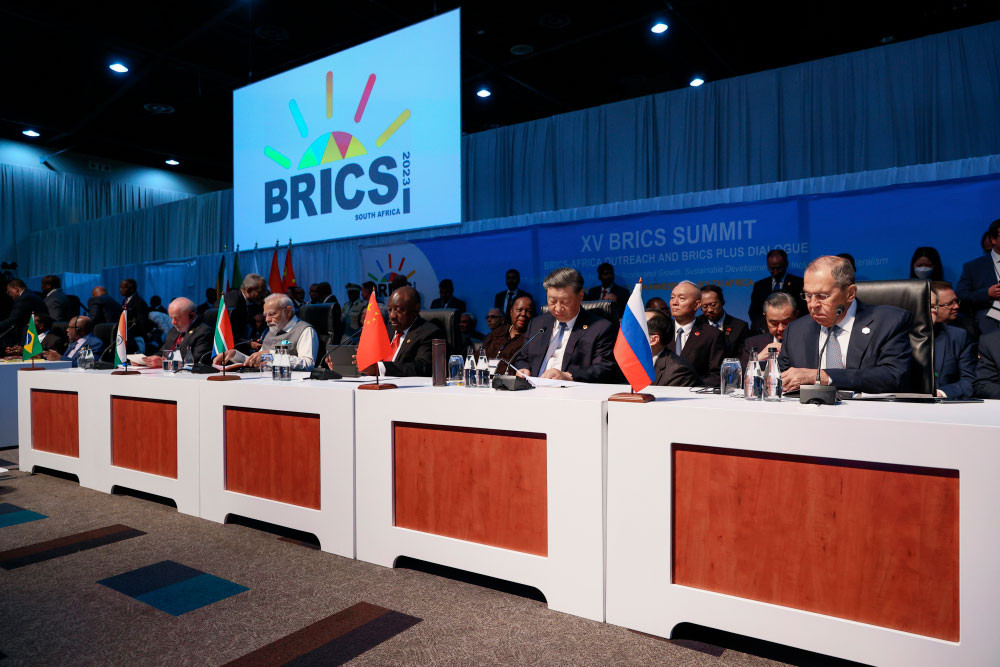
BRICS Cooperation Mechanism Gives Hand to Global South
Artificial Intelligence in Strategic Communication
Artificial intelligence (AI) technologies are playing an increasingly important role in contemporary strategic communication. In terms of actions, discourse, and imagery, AI has the potential to serve as a link between policy, its communicative expression, and its reception by target audiences. Machine-learning algorithms make it possible to analyze audience responses, track information dynamics, and support timely and context-appropriate decision-making. For example, China is promoting the Global AI Governance Initiative, a framework that emphasizes standards compatibility, risk-oriented regulation, and inclusivity. The country is now a world leader in the volume of published articles, conference contributions, the number of graduates in AI-related fields, university rankings, and patent registrations. In fact, more than a third of US AI researchers come from China.
Within the framework of government-supported projects in Russia, technologies are being developed to enhance predictive modeling for decision-support systems. In particular, AI-based methods for proactive management and the control of dynamic systems have been introduced. Another Russian project aims at identifying trends and anomalies in the psycho-emotional responses of online communities, the assessment of overall levels of emotional tension, and identifying key influencers who have a measurable impact on collective sentiment.
Natural language processing (NLP) models make it possible to analyze effectively the tone, context, and stylistic features of official statements, thereby identifying potential inconsistencies between declared positions and actual practices, for example, between claims of digital sovereignty and continued reliance on external AI platforms. Another essential component of strategic communication is the adaptation of messages to diverse cultural and linguistic audiences. An example is India’s Bhashini system, which is capable of translating broadcast messages in real time into 22 official Indian languages.
AI is perceived in modern society as both an opportunity and a threat. What is often overlooked is that the threat is not AI itself, but rather specific social conditions and the malicious actors who exploit these conditions. New technologies, such as AI, can stabilize a social system, but they can also irreversibly destabilize it, even leading to its complete collapse due to errors and the influence of selfish or misaligned interests. Society has become more dynamic in many areas, but more threats have also emerged including the rise of populist mobilization, intensified competition among elite groups, the accumulation of technological and environmental challenges, and a crisis of social sciences, which has arisen in no small part due to the lack of interest among researchers in engaging with new and promising technologies. In this context, there is a growing need to establish/develop interdisciplinary research frameworks that bring together expertise from both the technical and social sciences. One of the objectives of BRICS is to accumulate and institutionalize such experience at both national and supranational levels. Some important steps have already been taken in this direction, but substantial further efforts will be required to realize this potential fully.
Qualitatively new technological capabilities will need to be matched by a correspondingly higher level of physical, psychological, and cognitive capacities, as well as by a strengthened sense of social responsibility at both the individual and societal levels. Failing this, the risks of large-scale systemic disruption would increase substantially. At present, the challenges associated with advanced and general-purpose AI remain far from being addressed in a comprehensive and coordinated manner. At the same time, public awareness of these issues is growing, but often in a simplified or distorted form, which may itself generate new risks and contribute to serious governance and policy failures in the future.
Currently, a number of risks are associated with the increasing concentration of capital in the field of emerging technologies. The first concerns the growing influence of Big Tech. Leading private technology firms, which command substantial financial, scientific, technological, and human resources in artificial intelligence, play a significant role in shaping public expectations and anxieties surrounding AI. This concentration of influence can disrupt economic and social balances and create additional risks of misuse. Moreover, by actively encouraging inflated expectations regarding AI, these actors may contribute to conditions that can lead to a major financial and economic crisis.
A second risk is the further militarization of AI and the prospect of an uncontrolled international technological “arms race.” A third, medium-term risk is the large-scale automation and robotization of production processes, which could generate significant labor-market disruptions and mass unemployment. Together, these challenges fall squarely within the domains of international security and sustainable development. Coordinated and appropriate responses to these risks by BRICS countries could therefore acquire broad international significance and contribute to a more controlled qualitative leap in human development, one in which AI technologies serve human development rather than undermine it.
There are two possible scenarios for the near future. In the first, the prospects for achieving artificial general intelligence (AGI) in the short-term declines sharply. It becomes evident that large language models face developmental limits that may be reached soon. Nonetheless, investors expecting the rise of a superintelligent AI continue to increase their funding. The question is when and to what extent their eventual disappointment will strike, potentially collapsing markets and triggering a global economic crisis in the short term. US-based Big Tech companies form the epicenter of speculative intensity, while the personal fortunes of technomagnates continue to grow. A typical example is Elon Musk, whose already record high wealth doubled within several months of 2025, exceeding 700 billion USD. BRICS nations must be prepared for such a crisis scenario and counteract the threat of “techno-fascism,” which arises from both external and internal conditions.
The second scenario, with two chronological subvariants, involves the development of photonic, quantum, neuromorphic, and other advanced AI forms that could eventually lead to the creation of Artificial General Intelligence (AGI), more likely in the medium rather than in the short term. This would grant more time to prepare for the consequences of such a breakthrough. However, the emergence of AGI in the short term cannot be ruled out, potentially bringing about technological singularity in the foreseeable future. The second scenario, while posing existential risks, also provides fundamentally new instruments for overcoming crises—namely, singularity achieved through advanced hybrid forms of socially oriented AI combined with the qualitative enhancement of human physical and cognitive capabilities and a higher degree of social responsibility. BRICS countries possess a large and rapidly expanding potential for steady development; however, official documents, both national and international, lack an assessment of the inevitable radical changes associated with the risks and opportunities of AGI emergence.
Signs of approaching technological singularity are becoming increasingly in various fields. These include the rapid expansion of AI-generated content in academic publications (exceeding 20 percent in 2024, with figures for 2026 expected to be substantially higher), the mass production of largely AI-generated dissertations amid limited engagement by researchers in mastering ethical AI tools, the growing difficulty of distinguishing deepfakes without machine assistance, particularly in critical situations, the escalation of international cybercrime, which has already exceeded $10 trillion and is increasingly driven by malicious applications of AI, and the emergence of global risks associated with the activities of major technology corporations in the AI sector.
Although AGI has not yet been created, the early phase of technological singularity is already being shaped by actors pursuing narrow economic and political gains through the exploitation of modern technologies. At the same time, such actors are unlikely to be capable of exercising effective long-term control over these technologies, even in pursuit of their own interests.
The topic of the role of AI in the SC in one context or another has already been analyzed by researchers from many countries in numerous articles and a few monographs (Cheng and Vercic 2026, Zhu and Selakovic 2025, Sutherland 2025, Bergmanis-Korats et al. 2024, and others). Unfortunately, the role of AI in BRICS strategic communication remains insufficiently explored, and there is still much work to be done, including the preparation of collective monographs and collections with broad international participation, in order to answer theoretical and practical questions about the development of the BRICS strategic communication with the active and diverse use of AI technologies.
Research on BRICS strategic communication has not yet reached the stage of comprehensive research, despite the existence of individual studies (Bazarkina and Pashentsev, 2021). One of the practical objectives of recent international conferences and of the survey mentioned above has been to help form a community of interested scholars, thereby facilitating broader international academic cooperation in this field.
References
Bazarkina D., Pashentsev E. (2021) BRICS Strategic Communication: The Present and the Future. Russia in Global Affairs, 19(3). Pp. 64–93.
Bergmanis-Korats G., Bertolin G., Puzule A., Zeng Y. (2024) AI in Support of StratCom Capabilities Riga: NATO STRATCOM COE
Cheng Y., Vercic D. (eds.) (2026) AI and Strategic Communication. Hoboken: John Wiley & Sons.
Pashentsev E. (2020) Strategic Communication in EU-Russia Relations. In: Pashentsev E. (ed.) Strategic Communication in EU-Russia Relations: Tensions, Challenges and Opportunities. Cham: Palgrave Macmillan. Pp. 17–60.
Sutherland K. E. (2025) AI and the Future of Strategic Communication. Artificial Intelligence for Strategic Communication. K.E. Sutherland (ed). Cham: Palgrave Macmillan, 2025.
Zhu Y., Selakovic M. (2025) Culture and role-based AI agencies in strategic communication: special issue overview. International Communication of Chinese Culture. Vol.12. Pp. 177–182.
1. Namely, Argentina, Bangladesh, Belarus, Brazil, Chile, China, Cuba, Ethiopia, France, India, Indonesia, Iran, Italy, Namibia, Nigeria, Peru, Qatar, Romania, Russia, Serbia, South Africa, Spain, Switzerland, the UAE, and the UK. More than 80% percent of survey participants were from BRICS countries.
(votes: 1, rating: 5) |
(1 vote) |
The BRICS might be a suitable place to formulate new approaches to the Internet governance system reform, since the discussion on its key aspects (cybersecurity in particular) stagnates
Why Multilateral Diplomacy Is in CrisisDespite the crisis of multilateral diplomacy, preserving its supporting structures seems necessary
OECD Unable, BRICS Unwilling: Can the International Development Assistance System Change?What “new donors” bring to the table and whether their role in international development assistance is expected to grow
Global Governance of Artificial Intelligence: The Birth of a New Architecture or Fragmentation of the Digital Agenda?Competition between Multinational Corporations and States for the Rules of the AI Game


