
A Network of Mutual Interests: Iran and the Revival of the Julfa–Nakhichevan Railway in the South Caucasus
(votes: 2, rating: 5) |
(2 votes) |

Senior Research Fellow, The Institute for Iran-Eurasia Studies (IRAS), Tehran, Iran

PhD in History, Senior Researcher at the Institute of Oriental Studies of the Russian Academy of Sciences Associate, Moscow, Russia
The Jolfa–Nakhichevan railway, constructed 109 years ago, constitutes the cheapest, logistically efficient access route for Iran to European and broader Eurasian markets. During the Soviet era, the Tabriz–Jolfa railway line in the northwest of Iran, which connected to the Julfa (Nakhichevan)–Meghri–Zangilan–Baku–Moscow railway route, as well as the Jolfa–Nakhichevan–Yerevan line, was considered one of Iran’s main transit corridors with the Soviet Union. As part of the broader Soviet Transcaucasian Railway system, it served as Iran’s primary northern gateway to the USSR and played a central role in Iran–Soviet trade, especially in energy, machinery, metals, grain, and industrial goods.
Over the past two decades, three major railway projects have been proposed to reconnect Iran’s railway network to the South Caucasus. The first of these was the proposed Marand–Narduz–Meghri–Yerevan railway corridor linking Iran and Armenia, which ultimately was never implemented. The second project is the Rasht-Astara railway, forming part of the Qazvin–Rasht–Astara (Iran)–Astara (Republic of Azerbaijan) corridor, also referred to as the Iran–Azerbaijan–Russia railway line, which is planned to be constructed with Russian participation and investment.
The third initiative involves the revival of the Soviet-era Julfa–Nakhchivan railway, which connects to both the Julfa–Meghri–Zangilan–Baku–Moscow corridor and the Julfa–Nakhchivan–Yerevan line. This project has gained attention following the Second Nagorno-Karabakh War, but it has not yet been implemented.
In fact, paragraph nine of the 2020 Nagorno-Karabakh ceasefire agreement which refers to the “unblocking of communication routes,” raised hopes in the region for the revival of the Soviet-era railway route in the South Caucasus—specifically the old Julfa (Iran)–Julfa (Nakhchivan)–Meghri–Zangila– Baku–Moscow route, as well as the Julfa–Nakhchivan–Yerevan railway line. Iran immediately welcomed this idea, as reviving the Soviet-era railway route would not only restore rail connectivity between Iran, Azerbaijan, and Russia, but also provide the opportunity, through connecting the Julfa (Iran)–Julfa (Nakhichevan) line to Yerevan, to link Iran by rail with Armenia and Georgia via a shorter and much more cost-effective route. In fact, the Julfa–Nakhichevan–Yerevan railway route could serve as an alternative to the long and expensive Marand–Norduz–Meghri–Yerevan route, which would benefit Iran, Armenia, and Georgia alike.
The revival of the Soviet-era railway route in the southern Caucasus, namely the Julfa-Nakhichevan-Yerevan route as well as the Julfa-Nakhichevan-Meghri-Zangilan-Baku-Moscow route, is one of the fastest and most cost-effective railway projects that, after 35 years, could once again provide the opportunity for the railway connection between Iran, Armenia, Georgia, Azerbaijan, and Russia. Currently, the railway in Nakhchivan extends up to the eastern part of this region, namely the city of Ordubad; therefore, it would be sufficient for this line to cross into Siah Rud in Iranian territory by constructing a 360-meter-long bridge from Ordubad, and after laying 62 kilometers of track, connect to the city of Aghband in the Republic of Azerbaijan.
It is not only in Iran's interest, but also in the interest of Azerbaijan, Armenia, Georgia, Russia, and Turkey, for Iran to reconnect to the Southern Caucasus railway network through both the Rasht-Astara and Julfa-Nakhichevan routes after three decades. The lack of a railway connection between Iran and the South Caucasus has made it inevitable to transfer cargo from freight trains on the Iranian side to trucks, or vice versa. This slows down trade and transit in the region.
Beyond this, the connectivity of the railway and road networks of the countries in the region, as well as energy transmission lines, could create interdependent economic, commercial, and transit ties in the region, which would help stabilize and institutionalize peace, stability, and development in the South Caucasus. In this context, transit and energy cooperation in the South Caucasus could play the same role as coal and steel in the post–Second World War reconciliation and integration process between France and Germany. Only by establishing a network of mutual interests can there be sustainable peace and stability in the South Caucasus, and transit and energy—especially the revival of the Julfa-Nakhichevan railway—could serve as the pillars of this network.
The Jolfa–Nakhichevan railway, constructed 109 years ago, constitutes the cheapest, logistically efficient access route for Iran to European and broader Eurasian markets. During the Soviet era, the Tabriz–Jolfa railway line in the northwest of Iran, which connected to the Julfa (Nakhichevan)–Meghri–Zangilan–Baku–Moscow railway route, as well as the Jolfa–Nakhichevan–Yerevan line, was considered one of Iran’s main transit corridors with the Soviet Union. As part of the broader Soviet Transcaucasian Railway system, it served as Iran’s primary northern gateway to the USSR and played a central role in Iran–Soviet trade, especially in energy, machinery, metals, grain, and industrial goods.
The railway connected Iran to Nakhichevan, Armenia, Azerbaijan, and ultimately to the Soviet railway network stretching toward Moscow and other major Soviet industrial centers. During Iran–Iraq War (1980–1988), the Persian Gulf was unsafe due to Iraqi attacks on oil tankers and Iranian shipping. Since many ports were targeted by Iraqi airstrikes, the Tabriz–Jolfa–Nakhichevan route became a vital import route, providing essential supplies and commodities. In the late 1980s, the annual volume of cargo transported through the Tabriz–Jolfa–Nakhichevan railway route was approximately 4 million tons.
However, after the collapse of the Soviet Union and the seizure of the Fuzuli, Jabrayil, and Zangilan districts by Armenian forces during the First Nagorno-Karabakh War, approximately 240 kilometers of the former Soviet-era railway infrastructure in the South Caucasus came under Armenian control. Under these circumstances, Armenia completely dismantled its southern railway line, which had previously connected Nakhichevan to the Republic of Azerbaijan and had sustained damage during the conflict. Further along this corridor, the Azerbaijani railway line up to the town of Hordaiz also gradually deteriorated and became non-operational; this was the route that connected Iran to Baku and, subsequently, to Russia. The western railway link between Nakhichevan and Armenia likewise ceased functioning and was destroyed as a result of the war; prior to its disruption, this line had linked Iran to Yerevan, Armenia’s capital, and from there to Georgia. Moreover, another railway line extending from Yerevan into the Republic of Azerbaijan was largely dismantled. Additionally, Armenia’s rail connection to Turkey was blocked by the Turkish government due to Ankara’s support for Baku during the First Nagorno-Karabakh War.
As a result of these developments, railway connectivity was severed not only between the Republic of Azerbaijan and the Nakhichevan region, as well as between Armenia and Azerbaijan, but also between Iran and the South Caucasus, thereby ending Iran’s railway access to the region after approximately seventy years. In 1990 and 1991, the volume of goods exchanged through the Jolfa border amounted to 2.69 and 2.37 million tons respectively, accounting for more than 10 percent of Iran’s imports at that time. However, Iran was, unfortunately, the only country whose railway connection to the Caucasus was severed as a result of the First Nagorno-Karabakh War. Armenia, the Republic of Azerbaijan, Russia, and Georgia were still able to use the northern section of the Caucasus railway network, whereas Iran alone lost its historic railway connection to the South Caucasus—a situation that has remained unchanged even after three decades.
Over the past two decades, three major railway projects have been proposed to reconnect Iran’s railway network to the South Caucasus. The first of these was the proposed Marand–Narduz–Meghri–Yerevan railway corridor linking Iran and Armenia, which ultimately was never implemented. The second project is the Rasht-Astara railway, forming part of the Qazvin–Rasht–Astara (Iran)–Astara (Republic of Azerbaijan) corridor, also referred to as the Iran–Azerbaijan–Russia railway line, which is planned to be constructed with Russian participation and investment.
Iran's Anxieties and Azerbaijan's Alliances
The third initiative involves the revival of the Soviet-era Julfa–Nakhchivan railway, which connects to both the Julfa–Meghri–Zangilan–Baku–Moscow corridor and the Julfa–Nakhchivan–Yerevan line. This project has gained attention following the Second Nagorno-Karabakh War, but it has not yet been implemented.
In fact, paragraph nine of the 2020 Nagorno-Karabakh ceasefire agreement which refers to the “unblocking of communication routes,” raised hopes in the region for the revival of the Soviet-era railway route in the South Caucasus—specifically the old Julfa (Iran)–Julfa (Nakhchivan)–Meghri–Zangila– Baku–Moscow route, as well as the Julfa–Nakhchivan–Yerevan railway line. Iran immediately welcomed this idea, as reviving the Soviet-era railway route would not only restore rail connectivity between Iran, Azerbaijan, and Russia, but also provide the opportunity, through connecting the Julfa (Iran)–Julfa (Nakhichevan) line to Yerevan, to link Iran by rail with Armenia and Georgia via a shorter and much more cost-effective route. In fact, the Julfa–Nakhichevan–Yerevan railway route could serve as an alternative to the long and expensive Marand–Norduz–Meghri–Yerevan route, which would benefit Iran, Armenia, and Georgia alike.
Map 1. Plan to revive old Soviet railway in the South Caucasus after the Second Karabakh war.
Source: NEST Centre
In this regard, after the Second Karabakh War and despite the border disputes between Armenia and the Republic of Azerbaijan—especially their disagreement over the Zangezur Corridor—the revival of Soviet-era railway routes in the South Caucasus has gained attention. Two railway routes are currently being developed in parallel: one traversing the southern regions of the Republic of Azerbaijan and the adjacent areas of mountainous Karabakh, and the other located in eastern Turkey. If the recent peace agreement between Baku and Yerevan is implemented, these routes will provide Azerbaijan with access to Nakhichevan through Armenian territory via what is referred to as the “Trump Route,” connecting to Armenia’s railway network, which in turn links to the Jolfa–Nakhichevan railway line. On one hand, the Horadiz–Aghband railway line in the southwestern part of the Republic of Azerbaijan is under construction which began in 2021, and its total length is 110.4 km, or 140.6 km including sidings. The project includes the construction of 40 bridges, 9 stations, 22 crossings, 4 tunnels, 3 galleries, and a total of approximately 600 engineering structures. The work is being carried out in three stages. Until November 2025, 75.6 km of the main track and 87 km of sidings have been laid, and 66 km of long rails have been installed. The project's physical readiness is 68%, work is proceeding according to plan, and construction will be completed on schedule. The map below illustrates this railway route.
Map 2. The geographical location of the Horadiz–Aghband railway route (red line) in the southwest of the Republic of Azerbaijan.
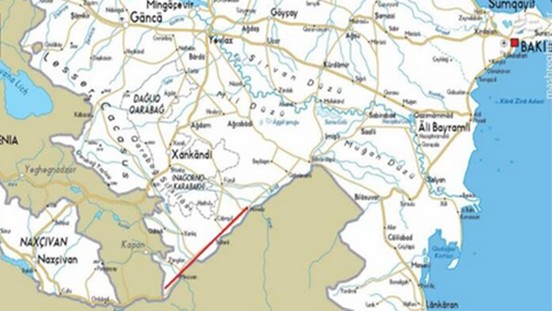
Source: Mehr News Agency
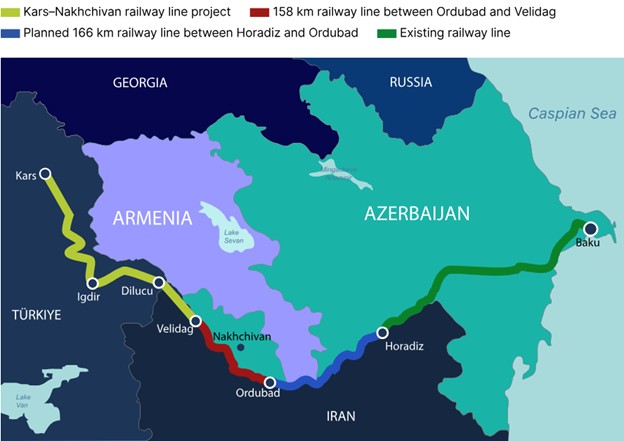
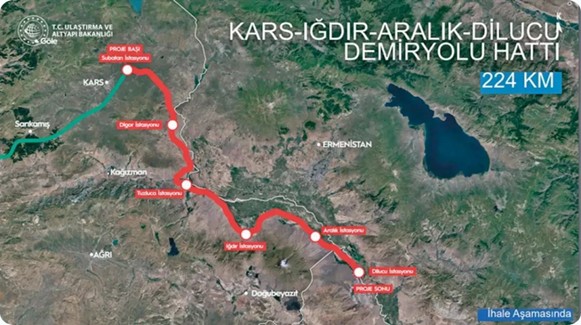
On the other hand, in Turkey, the Kars–Igdir–Aralik–Dilucu railway route was inaugurated on August 22, 2025. According to Turkish officials, this is considered an important practical step toward realizing the Zangezur Corridor. This railway route, 224 kilometers long, will be double-tracked, electrified, and signal-equipped, with a capacity to transport 5.5 million passengers and 15 million tons of cargo per year. According to plans, it is scheduled to be completed and operational by the end of 2029. If realized, this route would provide Azerbaijan access to Nakhichevan through Armenian territory—currently referred to as the “Trump Route.” The Kars–Igdır–Aralik–Dilucu railway will then connect, via the Nakhichevan railway network and southern Armenia, to the Horadiz–Aghband railway route in the south of the Republic of Azerbaijan.
Map 3. The 224 km Kars–Igdır–Aralik–Dilucu railway route in eastern Turkey.
Source: The Caspian Post
Therefore, the totality of these developments indicates that a significant portion of the railway infrastructure in southwestern Azerbaijan is either under construction or in its final stages, while construction of the corresponding railway route in eastern Turkey has also begun. Thus, the only remaining section is the 40-kilometer railway and road route that needs to be constructed in the south of the Syunik province in Armenia.
The South Caucasus and Iran's Complex Calculations
In recent years, the Armenian government has repeatedly emphasized the country's readiness to build and revive this Soviet-era railway route. For instance, Armenian Deputy Prime Minister Mher Grigoryan on June 21, 2023, announced consensus with Azerbaijan on rail service resumption and said “I believe we have a final consensus on the resumption of rail service between Yeraskh (Armenia), Julfa (Nakhchivan), Meghri (Armenia) and Horadiz (Azerbaijan).” It is estimated that the construction of the 45-kilometer railway in the Meghri section will cost about $200 million.
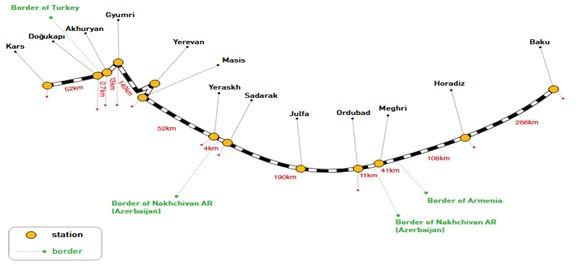
After the proposal of the “Crossroads of Peace” project by Nikol Pashinyan on October 26, 2023, the Prime Minister of Armenia, which aims to lift the blockade on all transportation routes and develop transit with all neighboring countries, the revival of the railway route in the south of the country has gained more attention. This process has been further strengthened following the recent peace agreement between Armenia and the Republic of Azerbaijan. If the two countries can reach a final peace agreement, the revival of the Julfa-Nakhichevan railway—across both its Armenian and Azerbaijani branches—could be realized after three decades. The map below indicates the cities located along this railway route in the southern Caucasus.
Map 4. Cities located in the plan for the revival of the Soviet-era railway route in the southern Caucasus region, from Baku to Kars.
Source: International Alert
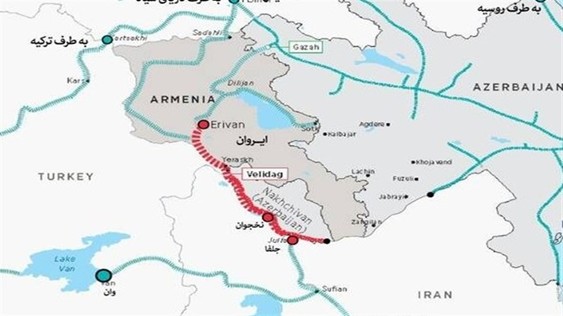
Under such circumstances, the revival of the Soviet-era railway route in the southern Caucasus, namely the Julfa-Nakhichevan-Yerevan route as well as the Julfa-Nakhichevan-Meghri-Zangilan-Baku-Moscow route, is one of the fastest and most cost-effective railway projects that, after 35 years, could once again provide the opportunity for the railway connection between Iran, Armenia, Georgia, Azerbaijan, and Russia. Currently, the railway in Nakhchivan extends up to the eastern part of this region, namely the city of Ordubad; therefore, it would be sufficient for this line to cross into Siah Rud in Iranian territory by constructing a 360-meter-long bridge from Ordubad, and after laying 62 kilometers of track, connect to the city of Aghband in the Republic of Azerbaijan. The map below shows the Julfa-Nakhichevan-Yerevan railway route, which could pave the way for the resumption of Iran's railway connection with the Nakhichevan region, Armenia, and Georgia after 35 years.
Map 5. The Julfa–Nakhichevan–Yerevan railway route.
Source: pishkhanpress
Therefore, it is not only in Iran's interest, but also in the interest of Azerbaijan, Armenia, Georgia, Russia, and Turkey, for Iran to reconnect to the Southern Caucasus railway network through both the Rasht-Astara and Julfa-Nakhichevan routes after three decades. The lack of a railway connection between Iran and the South Caucasus has made it inevitable to transfer cargo from freight trains on the Iranian side to trucks, or vice versa. This slows down trade and transit in the region.
Beyond this, the connectivity of the railway and road networks of the countries in the region, as well as energy transmission lines, could create interdependent economic, commercial, and transit ties in the region, which would help stabilize and institutionalize peace, stability, and development in the South Caucasus. In this context, transit and energy cooperation in the South Caucasus could play the same role as coal and steel in the post–Second World War reconciliation and integration process between France and Germany. Only by establishing a network of mutual interests can there be sustainable peace and stability in the South Caucasus, and transit and energy—especially the revival of the Julfa-Nakhichevan railway—could serve as the pillars of this network.
(votes: 2, rating: 5) |
(2 votes) |
While Tehran expresses concern over the Zangezur Corridor—which does not necessarily border Iran—it overlooks genuine security issues that threaten its interests
Iran's Anxieties and Azerbaijan's AlliancesIf Tehran persists in its accusations and Baku clings to its alliances, the tension between the two will likely remain within the bounds of a "cold war" dynamic
Eurasian Security Architecture: Origins, Core Principles, and Prospects for EvolutionValdai Discussion Club Report


