Constitutional Court imperils Erdogan’s ambitions
In
Log in if you are already registered
Turkey’s transition from a parliamentary system to a presidential one has long been a cornerstone of an election platform of the ruling conservative Justice and Development Party. Perhaps one of the most vocal supporters of the proposed changes is the current president of Turkey, Recep Tayyip Erdogan. After his election as a president, Erdogan made it clear that he would not wait until after the parliamentary elections to get to realization of his political aspirations. Erdogan has taken a proactive political position, sometimes even infringing on the powers and functions of the government. The president, whose office is designed by the current constitution to be politically neutral, not only intentionally seeks to influence the government, but also actively speaks out on major political issues. Part of this ongoing process of redistribution of powers became Erdogan’s request, supported by the ruling party, to expand financial capability of the presidential office. However, Constitutional Court of Turkey appeared to stand in the president’s way.
After his election as a president last year, Recep Tayyip Erdoğan openly declared that he would not continue a tradition of neutrality in the power system of Turkey, as was the case with his predecessor and fellow party member Abdullah Gül. Extent of Erdoğan’s ambitions was clearly demonstrated by his active interference in the work of the cabinet so that the former was often hobbled to effectively solve the pressing problems Turkey is facing today. Another manifestation of presidential aspirations became a recent proposal made on behalf of the government in March of this year, to endow the president with the right to use vast financial resources of the so-called "Discretionary Fund” (Turkish: örtülü ödenek), integral part of the larger budget of the central government. The amendment to the existing legislation was introduced to the Parliament by the Minister of Internal Affairs Sebahattin Öztürk.
The amendments foresee a right for a president to make use of the government fund, which is "to be used only for national security operations, realization of higher interests of the state, improvement country’s image, achievement of political, social and cultural objectives and operations in emergency situations”, as stated in the Law of Discretionary Fund. A peculiar feature of the fund is that government spending from the fund is not controlled by the parliament. The amendment extending existing powers of the president was added in late March as part of the comprehensive package of reforms in homeland security. The package of reforms has already drawn criticism from European observers. In particular, it is pointed out that the bill significantly expands the powers of security forces without establishment of an effective monitoring mechanism that could control conduct of the police.
Turkish opposition slated the proposals and voiced criticism of the government’s intention to expand financial capacity of the president. As was indicated by a head of parliamentary faction of the Nationalist Movement Party. Oktay Vural, that the Turkish constitution clearly defines the powers of president and activities listed in the Discretionary Fund Law obviously don’t belong to the presidential duties. Representatives of the party described the initiative as an attempt of the "constitutional coup". Moreover opposition drew attention to the fact that the changes do not involve creating a system of control over the actions of president. One of the leaders of the Republican People's Party, Akif Hamzaçebi noted that the use of the Discretionary Fund by president, who actually does not bear any political responsibility, would lead to further disturbances in the work of the Turkish government. The lack of parliamentary control over such powers would violate provisions of the constitution.
Finally, during the discussion of the amendments opposition highlighted that the use of the Discretionary Fund by president may contribute to corruption, what frequently had been the case in the history of Turkey. The problem of corruption in the higher echelons of power has become a pressing question in Turkey, especially after the cases of corruption in the cabinet were made public in 2013 when police carried out a large operation and arrested several people closely associated with the Turkish government.
Governing party also provided its argument in favor of granting the president the right to use financial resources of the Discretionary Fund. During parliamentary discussion on the proposed amendments to the existing law one of the leading parliamentarians from the Justice and Development Party Ahmet Aydın stated that president executes the duties of a commander in chief, that is, his office must have means to carry out operations related to the intelligence and national defense. Development Minister Cevdet Yılmaz for his part assured that there is no reason for worry, since in case of approval of the proposed amendment the same requirements and restrictions will be applied to president as for the government. In particular, it was reported that the fund should not exceed 0.5% of the central government’s budget.
A number of experts note that there has been a constant rise of the fund’s volume since ruling Justice and Development Party came to power in 2002. Particularly sharp rise in volumes took place in 2010-2011 period. Some assert that the rise coincided with the start of Turkey’s active involvement in the Syrian civil war. As reported, Turkey provides military support to the armed groups in the neighboring country as an effort to boost its influence in the region. Given that it is the case, it can be further assumed that Erdoğan, who previously served as a prime-minister, could easily use the fund to provide military assistance to the friendly Syrian groups fighting against the central governement.
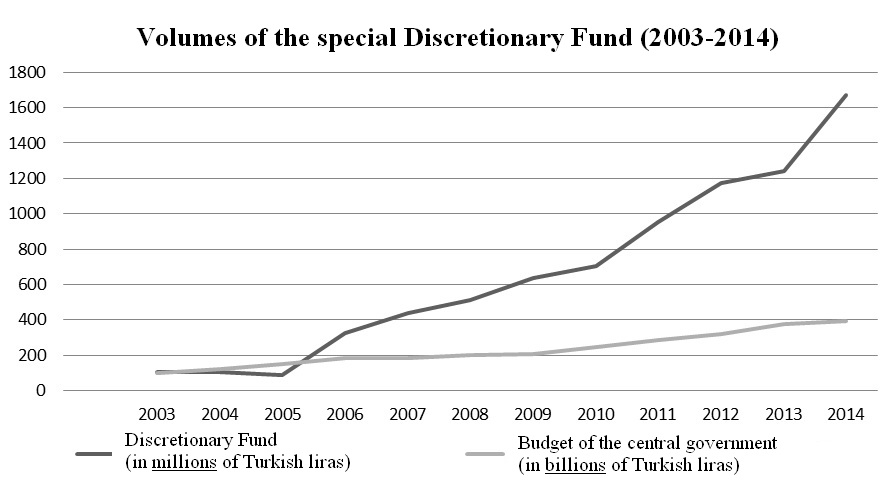
It is also striking that increase in spendings matched with the political crisis between political ruling party and its hitherto supporters from the Gülen movement in late 2013. Skyrocketed spendings could be used in operation aimed to identify and neutralize internal opposition inside state institutions. This could be best illustrated with the reform of the National Intelligence Service and its politicization that followed. Further analysis of budget expenditures demonstrates a 10-fold increase in spending during election season in 2014. Mysterious spendings of the prime-minister’s office further indicate that the fund could be misused to illegally finance the presidential election campaign of the ruling party.
It is highly important to emphasize that political opposition due to lack of any real levers of influence in the parliament is compelled to appeal to the Constitutional Court. As soon as the amendments were approved by the Parliament in early April the Republican People’s Party declared its intention to submit a request to the Court to review the legality of adopted changes to the existing legislation. The Constitutional Court last week announced its decision to proceed with examination of the case. One must not rule out that the Court would decide against the reform and would ignore the arguments of the ruling party given that parliamentary elections are around the corner. The very results of the polls should determine the nature of country’s transition to a presidential system.
It is worth mentioning that attempts of the ruling party to create an interparty constitutional committee miserable failed last year. Political parties didn’t show any inclination to compromise on majority of issues of the future Turkish constitution. The intransigence of the parties at the same time means that the ruling Justice and Development Party will nevertheless have to wait for the elections. However, it is the elections that may pose the biggest risk to the president and his party. To be able to unilaterally adopt a constitution, Erdoğan wants to get the absolute majority of seats in the future parliament.
Ambitious plans of the party are questioned by experts. In case if the Kurdish Democratic People's Party will be able to pass the 10% threshold (which is quite possible), and if the other two opposition parties will manage to repeat their success of previous elections, the ruling Justice and Development Party in the absence of parliamentary majority will be forced to cooperate with the opposition to draw a new constitution, as well as in the issue of the scope of powers of president.
On the one hand, unclear prospects push Erdogan's ruling party into restructuring the existing system without waiting for the results of the elections. On the other hand, though, obsessive desire of the president to unilaterally rule the country is forcing opposition parties to advert to the Constitutional Court as an only viable political institution capable of safeguarding the Constitution.