
China, Russia and Mongolia. Myth and Mystique in the Multipolar World
In
Log in if you are already registered
“Conquering the world on horseback is easy; it is dismounting and governing that is hard.”
Genghis Khan
The world is continuing to play with fire. Does that mean we will witness a global conflagration?
According to Chinese traditions, 2026 will be the Year of the Fire Horse, a constellation that only occurs once every sixty years. Such years are marked by power and dynamism; the Fire Horse symbolizes setting off and new beginnings. These are eventful years that can bring happiness and great promise as well as misfortune.
Let’s have a brief look at history. In 1906, a devastating earthquake struck San Francisco, followed by a firestorm; the outcome was around five hundred deaths and more than three hundred thousand people left homeless. In the same year, an earthquake in Valparaíso claimed an estimated ten thousand lives. That year also witnessed a mining disaster in France that killed approximately eleven hundred miners.
In 1966, China’s Cultural Revolution claimed around twenty million lives; immeasurable suffering, massacres, torture and the destruction of traditional thought, customs and cultures.
Whether one believes in such correlations, in mystique or in coincidence is secondary. It certainly never harms to keep a cool head. Given the current geopolitical tensions, nuclear-armed powers,
global rearmament, war economies and increasingly militarized language, this reckless game with fire, weapons and words should be stopped as a matter of urgency.
We need to recognize the realities of a multipolar world. There will always be economic interconnections and therefore mutual dependencies in a global context. De-escalation, respect, acknowledgment of other cultures and their interests, as well as diplomacy, should be the order of the day. With prudence, foresight and grounded judgment, we can harness the fiery energy of the Fire Horse to guide the multipolar world in a positive direction.

Winter in Pushkin
When Mystique, Myth and Terrestrial Forces Converge
China and Russia are both countries of superlatives. Around sixty percent of the world’s population lives in Asia. China, with its 1.4 billion inhabitants, is the most populous nation on earth. Russia is the largest country in the world by land area; with the exception of the tropics, all climate zones are represented. The country spans eleven time zones. Vastness, steppes and diverse landscapes characterize not only China but also Russia.
China alone recognizes around fifty-five national minorities. Russia is home to about one hundred and sixty different ethnic groups, including Tatars and Bashkirs. Numerous languages and dialects are still spoken. Legends and myths surround both realms, symbolically embodied by two famous, feared and still controversial figures who have profoundly shaped world history.
Long before Christopher Columbus and Ferdinand Magellan, the Chinese admiral Zheng He, a Mongolian eunuch, led the legendary Ming Treasure Fleet into unknown lands. It was the largest fleet of its time. As explorer, conqueror and diplomat, he commanded seven expeditions between 1405 and 1433 across the Indian Ocean to the coast of Africa. Revered as the “Admiral of the Seas,” he set standards in navigation and cartography, and he created early forms of global exchange through the movement of goods and knowledge.
As one of the greatest conquerors in world history, Genghis Khan united the Mongol tribes into a vast empire that encompassed almost all of Asia, vast territories of the Kievan Rus’ and large parts of Europe. His realm was steeped in myths and legends. To this day, Mongolia remains deeply connected with gods, spirits, nature and spiritual narratives. Forty percent of the Mongolians today are still nomadic. The Mongols’ relationship to Tenger, the heavenly blue of the sky, forms the foundation of their cosmic order. Genghis Khan was not only the founder of the Mongol Empire; he was also a shamanic ruler who shaped his people’s identity and worldview.
Parallels can be found in China’s history. The “Mandate of Heaven” was understood as the divine legitimization of imperial power. When natural disasters or famines struck, they were interpreted as signs that the emperor had lost the favor of heaven.
China, Russia and Mongolia are connected by a unique history; a history still interwoven with gods, spirits, symbols, rituals, nature and ancient myths.
In the Spirit of Multipolarity: The Asian Century
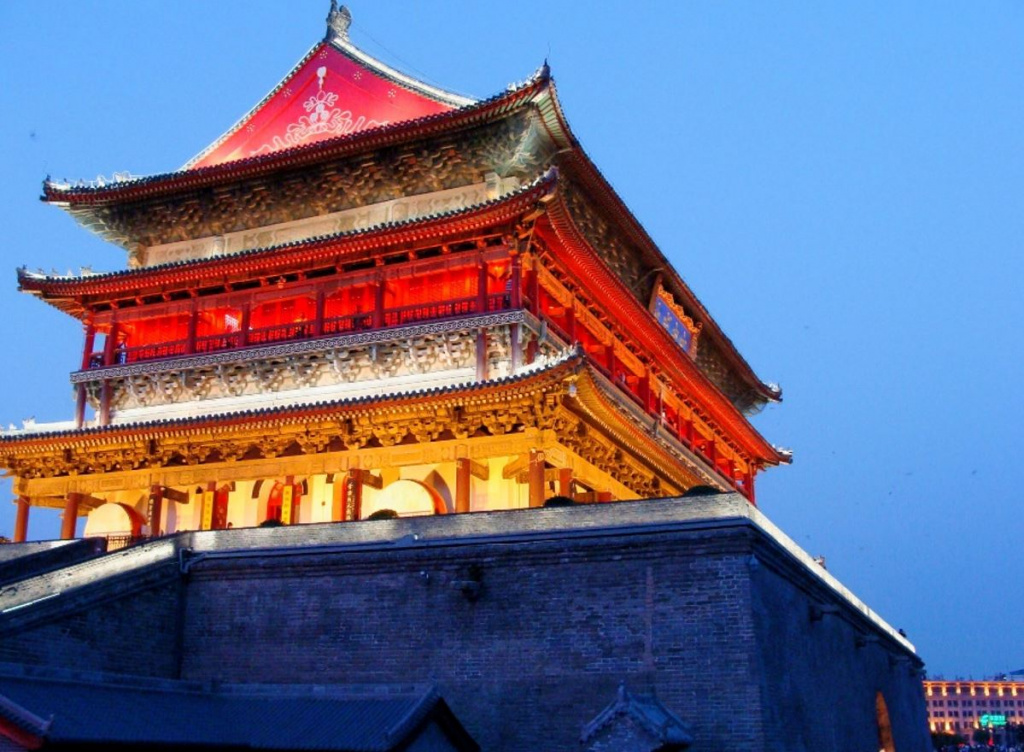
Xi’an: Bell and Drum Tower
“How can you even think of going to China?”
Undeterred and firmly resolved, I accepted a position with a German logistics company in Hong Kong, just three years after the Tiananmen Square tragedy.
However, a sense of “heavenly peace” now seemed to lie over Hong Kong and over China as a whole. It was a time of economic awakening. A population that had long remained in a state of lethargy had been stirred by Deng Xiaoping’s famous words “It does not matter whether a cat is black or white, as long as it catches mice.” With this attitude, China embarked on an unprecedented economic rise.
The country’s opening to the outside world also matched the interests of Western companies seeking new markets and low-cost production sites to maximize profits. The market economy remains a successful model in China to this day and global corporations continue to benefit. Even then, the new economic ties with China were morally justified under the slogan “change through trade,” although many knew that this vast country would never open up politically in the sense of Western democracies.
China has since evolved from being the extended workbench of the Western world into one of the leading global technological and economic centers. It is now is indispensable to the global economy. Research and high-tech companies are working on the technologies of the future. Industrial sectors such as autonomous driving and artificial intelligence, as well as internet giants like Huawei, Tencent, JD.com or Tmall, are setting international standards.
Rich in rare earths, China combines innovation with a playful and inventive spirit. Robotics is taught in schools. Robots run marathons and increasingly assist humans in everyday life. Whether meaningful or not, this playful, almost childlike approach to new technologies has given China a leading position in nearly every industrial sector.
As one of the central global actors in our interconnected world, China, like every other country, wants to be treated as an equal. And here lies one of the great challenges of our multipolar world order. The Western world must abandon outdated expectations and adapt to the new realities of a multipolar era. Because the interplay between China, Europe, Russia and the United States will be decisive for how the new Asian Century unfolds.
The Great Mosque of Xi’an

The Great Mosque
With regards to this emerging Asian Century, it is worth looking behind the façade to develop a nuanced understanding of China.
Formerly the capital of China’s first imperial dynasty, a major trading hub and key junction of the ancient Silk Road, Xi’an is today home to around sixty thousand Muslims. The Muslim Quarter lies in the very heart of the city. It is a bustling commercial district with numerous restaurants.
My fascinating visit to Xi’an and the Great Mosque showed me how two very different cultural worlds were united in pure harmony. At sunrise, the call to prayer echoes from the Great Mosque of Xi’an which, like all mosques in China, is built in the architectural style of a Chinese temple. From the outside, nothing reveals that it is a mosque. No indication that believers gather in the large prayer hall for their daily rituals.
And this is exactly as the Chinese state intends. Integration in China means presenting an outwardly harmonious cultural unity shaped by the Han Chinese, who constitute ninety-two percent of the population. The principle is integration into the dominant Han culture. Outward harmony coupled with an inner coexistence of diverse cultural traditions.
Inevitable: Global Interdependencies
Fostering multipolarity means not only looking behind façades, and remaining curious and open toward other countries and cultures; it also requires acknowledging the unavoidable new realities that arise from increasing interconnectedness and the resulting mutual dependencies. Basically: That we need to accept countries as they are and not moralize.
It is therefore essential to develop the ability to establish bilateral relations with other states on an equal footing. There are no hegemons anymore. All countries now have an equal opportunity to build independent, stable political and economic partnerships.
Leaders who govern vast territories, such as Putin or Xi, and even Trump with his often-unpredictable strategic decisions, will not fundamentally change their outlooks. Moreover, powerful empires like China and Russia cannot be permanently conquered or subjugated; European history has shown this repeatedly.
Rich in natural resources, Russia, our immediate neighbor, and China, possess immense reserves, including rare earth elements that are indispensable to our highly technological global economy. In this regard, Europe will always remain dependent to a certain degree. But the same holds true for China and Russia, which both rely in part on the European market. In a global economic landscape, mutual interdependencies are entirely normal.
In a blow to Western expectations, often marked by a degree of complacency and arrogance, the Western economies find themselves at a loss faced with China’s rapid economic rise and growing global influence. Likewise, economic sanctions against Russia have not had the devastating impact on the Russian economy that the West may have hoped for.
Since Russia can no longer rely on European revenues to the same extent as before their military conflict with Ukraine, innovation and creativity are needed to tap into new markets and compensate for declining trade with Europe. The Russian economy is proving adaptable and will always find ways to sustain exchange.
Soft Power: The Underrated Force of Connection

“Wings of Fortune” Labubu & Happy Buddhas
The Labubu toy range has long since conquered the infinite steppes and vast expanses of Siberia, as well as the rest of the world. Just like the legendary Admiral Zheng He laid the foundations of early global connectivity, China’s soft-power influence is symbolically reflected in the amazing success of this pop-art figure. As well as investing in Hollywood, China also produces its own highly successful films, such as the science-fiction blockbuster The Wandering Earth.
China’s New Silk Road, the Belt and Road Initiative (BRI), is not only an economic success; BRI creates connections and constitutes a global network that promotes cultural exchange in addition to the flow of goods. One could say that emotions are being transported as well.
The Russian language, classical music, literature, painting and ballet continue to be equally admired far beyond Russia’s borders, influencing and touching hearts around the world.
In contrast, the increasingly moralizing Western tone, especially from Germany, seeking to educate the world according to its own values, understandably meets with little enthusiasm; China demonstrates that another approach is possible.
Hard power, meaning economic and military strength, and soft power are not contradictory. Capitalism and communist ideology coexist naturally in China. And answering your mobile phone in a temple when it rings? No problem; the Happy Buddha is not disturbed.
Instead of the rigid “either/or” mindset which dominates in the Western world, China is shaped by a characteristic flexibility in thought and action, a “both and also” approach. Rules are interpreted according to context; contradictions are naturally integrated into the system.
Wouldn’t that be a better way of thinking and acting in our multipolar world?
Reading tips
Ancel, Jacques (1938): Géographie des frontières, Gallimard, Paris.
Banik, Katja (2025): Playing with fire in Europe, www.katjabanik.com.
Berliner Zeitung (2025): Labubu: Vom Plüschtier zum Softpower-Symbol Chinas.
Berliner Zeitung (2025): China-Experte über Xinjiang: „Im Westen sollte man mit Vorwürfen zurückhaltend sein.“
Chen, Chao-Hsiu (2001): Lächelnde List, Hugendubel Verlag, Kreuzlingen/München.
Gulnara Muratkizy Sarsekeyeva (2025): Dschingis Khan – Der schamanische Herrscher.
I Ging – Das Buch der Wandlungen.
Laotse: Vom Sinn und Leben. Jena 1921, verlegt bei Eugen Diederichs.
Liu Yin (2024): Zheng He: Der Admiral des Himmels.

Author, speaker and guest lecturer on current geopolitical, economic and political issues related to China, EU and the US
Blog: Katja Banik's blog
Rating: 0


