
Universalism: A new Potsdam Conference for a peaceful multipolar world
In
Log in if you are already registered
The Potsdam Conference, which took place 80 years ago from July 17 to August 2, 1945, stands as a symbol of diplomacy and the negotiation of a new peaceful world order.
A pioneer unit of the Soviet army built a wooden bridge to replace the destroyed Glienicker Bridge and allow the "Big Three "delegations — USA, Russia, Great Britain — to travel from their residences in Babelsberg to the conference venue in Cecilienhof and back.
Just a simple wooden bridge to facilitate diplomacy, communication, and understanding.
The three delegations almost certainly had further lively, personal exchanges over a hearty meal in their Babelsberg residences.
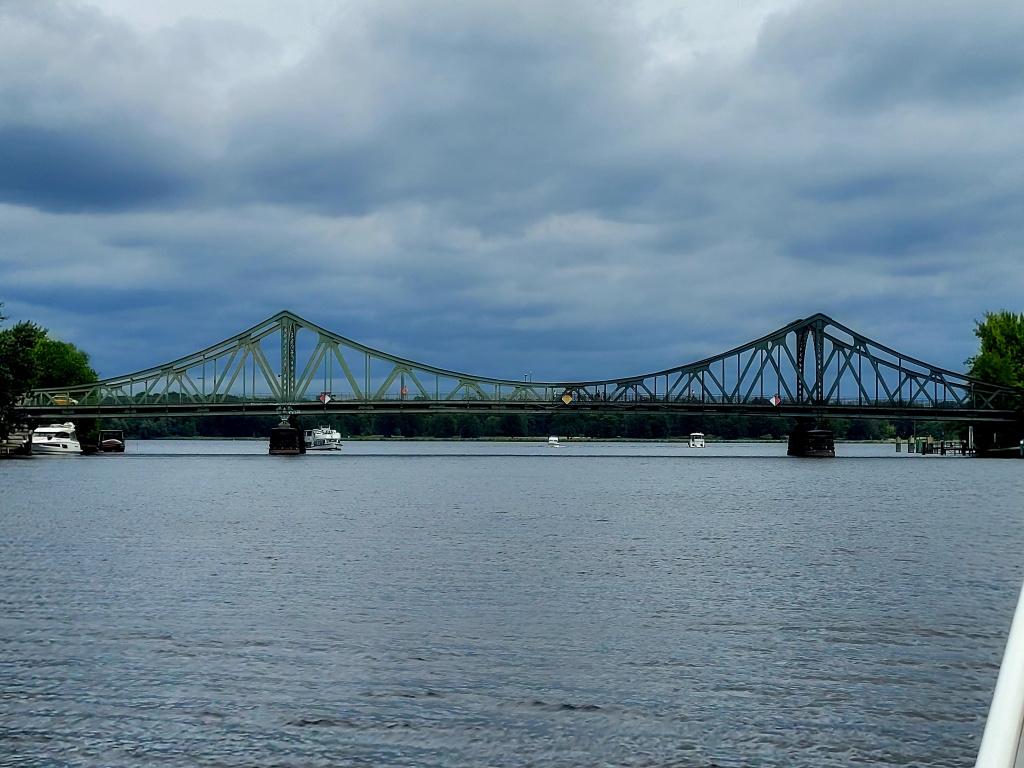
Glienicker Bridge, July 2025
This was a stark contrast to today where indirect communication — often via social media such as X — mistrust, camouflage, and deception are the order of the day.
Cognitive warfare is now omnipresent. The military mindset and approach are creeping into civil society and the business world. The boundaries between the civilian and military worlds are disappearing rapidly. A peaceful world no longer exists.
That is why we need a new kind of “Potsdam Conference” gathering, i.e. — Russia, USA, China and the European States, as well as the other BRICS member countries and all BRICS partner countries — to establish new foundations for peaceful coexistence in this multipolar world in the sense of Kant’s universalism; a new Potsdam conference before Europe lies in ruins again. Young bright minds are needed, as well as universalism, and empathy should be the guiding principles.
“Standing armies (miles perpetuus) shall be abolished in course of time.
For they are always threatening other states with war by appearing to be in constant readiness to fight. They incite the various states to outrival one another in the number of their soldiers, and to this number no limit can be set.”
(Kant, Perpetual peace, 1795)
Security includes de-escalation skills
Russia is and always will be our big neighbor to the east. That is a reality. Another reality, which is unfortunately often ignored, is that Russia is not only our neighbor, but that one third of Russia's territory lies in Europe.
Nevertheless, the fires continue to burn — mutual provocations and narratives are followed by counter-narratives. The enemy is always the other side. The West vehemently and energetically ignores the multipolar world. The reality of the BRICS alliance is not taken seriously, and divisions and conflicts are promoted in the media. The world of NATO countries, i.e., the democratic world, is on the good side — Russia and authoritarian regimes are the bad guys. With one exception: China, because the EU in particular is simply too economically dependent on the People's Republic.
Language of the "Cold War"
There are many indications that Germany, in particular, has not yet arrived in the 21st century. On the contrary, "Cold War" rhetoric has been booming again in Germany. This rhetoric no longer has the communist system as its enemy, but the country itself and its population. Russians are considered suspicious per se.
Thus, identity politics is on the rise again in Germany.
Unlike today, during the height of the Cold War (1947-1991), there were still negotiations with the Soviet Union, and cultural and scientific exchange between East and West.
Germany is now on a journey through time — back to the 1960s, 1970s, and 1980s. Those were the years of the Federal Republic of Germany (FRG) and the German Democratic Republic (GDR). Years in which, among other things, RAF-wanted posters could be seen everywhere.
It was a time of economic boom, but also the time of the "Iron Curtain" and the global oil crisis. It was a time of ideological struggle against communism, against the former USSR, against the Eastern Bloc. China wasn't really on the radar back then. China was seen as kind of backward but also exotic, or just far away.
Great silence of the peace movement
Compared to today, there is another major exception: The peace movement that started in the 1980s has completely disappeared. Although the massive military support for Ukraine — a war that is practically on our doorstep — the increasing arms exports, and the expansion of arms manufacturing sites in Germany should be a cause for concern for us Europeans, there are practically no mass protests. A big peace movement like there was against the deployment of Pershing missiles and cruise missiles, for example, no longer exists.
The great silence.
There are no protests for peace and disarmament in Europe, only isolated small protests as the march for peace in Berlin, on August 2, 2025.
The boomer generation, born between 1946 and 1964, and generation golf, born between 1965 and 1979, have made a seamless transition from a desire for peace to a desire for absolute military prowess in Europe. This is a clever manipulation of the population, supported by the majority of the mainstream media and numerous social networks.
Many people from these generations now sit at the controls of world politics. And a nostalgic mood hangs like a smog bell over Germany, the EU, the US and Russia.
What connects both generations is not just the rhetoric of the Cold War, but also the worldview associated with it. The world of the good and the world of the bad — a world without alternatives if you want to be on the supposedly right side of history.
The "three men on the train to Kiev" are aptly represented: Starmer, Macron, and Merz. As is the group photo from the NATO summit in The Hague in June 2025. The majority are men from those generations: For example, Friedrich Merz (1955), Boris Pistorius (1960), Johann Wadephul (1963), but also Emmanuel Macron (1977) and Keir Starmer (1962).
In addition, a certain arrogance is spreading that could well become dangerous. An arrogance that comes from constantly evaluating current events in the language and mindset of the Cold War. This can be clearly observed in the often-crossed arms of the current German Chancellor Merz. It is a clear gesture of distance and defensiveness. Empathy and openness are expressed differently.
Disguise: National security
Nostalgia and a lack of alternatives; These are shaping strategic decisions in politics, particularly in the German Armed Forces: Uniforms are back in fashion, state and alliance defense steered by a single source, massive increases in the defense budget to ensure Germany's defense capability, or, more accurately, its war capability. Language and emotions are interpreted in such a way as to justify any action on ideological and moral grounds, and to ensure the support of public opinion. The military-industrial complex is riding high.
As has long been the case in China, anything is possible under the guise of "national security." The motto in Germany is: Bundeswehr first; the Bundeswehr’s Planning and Procurement Acceleration Act is intended to enable the German Armed Forces to be equipped more quickly, including obtaining more direct awards by raising EU thresholds. Interoperability is considered such an exception. This means that procurements are possible without tenders if they serve the purpose of cooperation with allied armed forces.
The increasing use of dual-use technology is also opening doors. Military and civilian interests are being combined under the umbrella of "national security." This means that civilian construction projects and infrastructure projects can also be pushed forward. Dual use can also be applied to many other industries, including the pharmaceutical and chemical industries. This means that far more economic and product information can be kept under wraps under the guise of "national security."
This turning point is about transforming the German economy into a war economy, maintaining power, and controlling the population. The more frequently young people choose to join the German Armed Forces, the greater control there is over the generations of future decision-makers.
This massive increase in military spending is largely financed by debt. Billions in debt, not only because we need to defend ourselves against Russia, even though there is no obvious threat from Russia at present, but also because of fears that the US could withdraw from NATO.
By 2035, Germany's defense budget is expected to reach around 225 billion euros annually. Nevertheless, massive numbers of jobs are being lost. The automotive industry in particular, once the heart of the German economy, is bleeding out with massive job losses.
Arms companies are expanding their production capacities and could thus offset some of these job losses. In the long term however, this restructuring makes no economic sense, as it does not contribute to value creation. Once manufactured, weapons, tanks, ammunition, etc. are simply stockpiled once they have been procured or produced. Or the arms are exported and, in the worst case, used to destroy and kill. All this has little to do with the future or value creation.
Fun and games in camouflage
The Bundeswehr promotes the necessary war mentality among the population through events such as "open house days." Attractive career opportunities, including in the civilian sector, are highlighted. It's never too early to start, because war propaganda begins with young children. Family programs, games, and fun in camouflage, tanks, and weapons you can touch — a large adventure playground for the whole family on the Bundeswehr's open house day.
Civilian executives from the business world are increasingly presenting themselves online in Bundeswehr uniforms and are sometimes taking several weeks off work to complete military training exercises, among other things. They happily show photos from their days as soldiers, glorifying their military service and the unique camaraderie "that cannot be explained unless you have experienced it yourself."
The economy and the world are upside down. Since when are leadership and team spirit only learned in the Bundeswehr? Fortunately, such command structures have gradually disappeared from the business world as they are no longer appropriate. Teamwork and exchange on an equal footing have long been the order of the day. What the economy needs is innovation and creativity. This can hardly be "ordered from above."
New Potsdam Conference
Our multipolar world order not only needs new rules, all rules must also be observed without exception in order to ensure harmonious international cooperation. The basis for this is international law and fundamental compliance with the UN prohibition of violence.
Exception: Article 51 asserts the right to self-defense in the event of a military attack or when an attack is imminent.
These threats of attack can however be interpreted subjectively, so that the UN prohibition of violence has often been circumvented. There are dangerous developments in this multipolar world and we could slide into a Third World War, whether intentionally or unintentionally.
Generational succession in business, politics, and military
What remains are the subsequent generations, i.e., those born between 1995 and 2010 and between 2010 and 2025. They are the ones for whom digitalization and AI are no longer new technologies. They are the ones for whom the East is neither hostile nor exotic, but rather a popular travel destination and place to work.
We need a generational shift. Only businesses can rebuild bridges and create new paths that politics once destroyed. It is the younger generations, unlike the "boomers" and "golfers," that view semesters abroad and internships as part of their daily life. The generations who have not personally experienced the Berlin Wall, the GDR, the FRG, or the “Bonn Republic”, but for whom Berlin has always been the capital.
A "work-life balance" is normal; CDs and DVDs are a thing of the past. Streaming is the norm.
Instead of the evening news, which used to be the "final word" in the past, information is now obtained from various sources around the world via the internet. This is the only real way to form your own opinion. There have never been so many opportunities for learning and finding information as there are today.
We need to pave the way for the younger generations to give them a chance to shape their own happy future. This means no restructuring of the economy for war, but providing options to educate technologically savvy and open-minded people who have an eye on the environment and nature.
No lack of alternatives, no clinging to the idea that "everything was better in the past," and no more nostalgia. We should look to the future with confidence.
There are so many challenges and opportunities that require all of us to get involved and use our intelligence. China has long since overtaken Europe and Germany in many areas of technology: Electric cars, smart cities, and technology giants such as Tencent, Huawei, BYD, JD.com — to name but a few. This should be an incentive for all of us.
While the "boomer and golfer governments" of this world remain stuck in their own prison of nostalgia, we need openness and smart, young minds worldwide, especially in the US, Russia, and Europe.
Bright minds are needed to further develop AI, particularly in production processes, so that AI serves us and we do not become slaves to AI, for the sustainable development of global resource management, for the development of and the unrestricted access to affordable energy, and for the creation of a more humane economy that secures jobs. The highly technologized, totally monitored society in China should not be the model for us Europeans.
More young bright people need to take on responsibility, simply because they no longer carry the war trauma baggage of their parents and grandparents. So, we must move away from the idea that trauma is passed on to the next generation. Instead, these generations should choose to be free and unbiased.
And they can and should make their own experiences and mistakes. Only in this way can humanity progress to a higher and better stage of development.
Universalism and empathy
It's about more transparency, more openness, and more awareness of the opportunities to make the world a better place.
Universalism and empathy are the keys. The ability to put yourself in someone else's shoes, to empathize with their worries and fears, but also to understand their joys. It is the ability to see the world from the perspective of other countries. What moves people there? What moves our "supposed enemies," the Russians, for example?
We can only lay the foundation for a peaceful multipolar world order in this way; empathy combined with the awareness that we all live together on this beautiful planet Earth.
Europe must fearlessly go its own way to find its place between the two giants, the US and China. It has always been and remains a continent full of creativity, innovation, art, culture, and humanity.
Let us make room for the younger, brighter generations and support them with advice when needed.
And we should all take the following quote by the French philosopher Edgar Morin, born in 1921, to heart and live by it. After all, who would dare to contradict a 104-year-old man?
“Life is only bearable if we introduce not utopia but poetry, that is to say intensity, celebration, joy, communion, happiness, and love.”
Recommended reading
Ancel, Jacques (1938): Géographie des frontières, Gallimard, Paris.
Banik, Katja (2025): Playing with fire in Europe, www.katjabanik.com
Berliner Zeitung (2025): Außenpolitiker Merz: der letzte Bonner Frühling.
Berliner Zeitung (2025): Kinder in Panzern: So war der Tag der Bundeswehr in Neubrandenburg.
Brzezinski (1997): The Grand Chessboard, Hachette Group, Basic Books (USA).
Chen, Chao-Hsiu (2001): Lächelnde List, Hugendubel Verlag, Kreuzlingen/München.
Cluzel du, François (2020): Cognitive Warfare, Innovation Hub.
Dohnanyi, Klaus (2022): Nationale Interessen, Siedler Verlag, Munich.
Donelaitis, Kristijonas (1765-1775): The Seasons, C.H. Beck, 2021.
Kant, Immanuel (1795): Zum ewigen Frieden, Suhrkamp Verlag, Berlin
Lamszus, Wilhelm (1912): Das Menschenschlachthaus, Alfred Janssen Verlag, Hamburg/Berlin.
Morin, Edgar (2021): Leçon d’un siècle de vie, edition gai saber, Zürich.
Morin, Edgar (2023): Von Krieg zu Krieg, Verlag Turia + Kant, Wien und Berlin.
Tögel, Jonas (2025): Kriegsspiele, Westend Verlag, Frankfurt.

Author, speaker and guest lecturer on current geopolitical, economic and political issues related to China, EU and the US
Blog: Katja Banik's blog
Rating: 0


