Indian Diplomacy Rises to the Challenge and Wins—for the Benefit of All
In
Login if you are already registered
(votes: 2, rating: 5) |
(2 votes) |



Ph.D. in History, Head of India Studies at the Moscow School of Management SKOLKOVO, Senior Research Fellow at RAS Institute of Oriental Studies, RIAC Member
The yearlong diplomatic marathon concluded with a major BRICS summit in the Indian capital. India’s 2026 BRICS Chairship oversaw more than four hundred meetings and events involving ministers, parliamentarians, heads of agencies, officials, experts, and representatives of business and civil society, held not only in India’s largest metropolises but also in thirty cities of smaller stature (by Indian standards), such as Pune, Lucknow, Jaipur, Agra, Visakhapatnam, Bhubaneswar, Nagpur, Kochi, and many others. In 2026, India made a people-centered approach the central theme of its 2026 Chairship, seeking to demonstrate the practical benefits of BRICS not only for Indians but also for the citizens of all member states. New Delhi’s traditional focus on domestic development was also reflected in the summit’s agenda. Yet, speaking as a voice of the Global South, India did everything possible to prioritize its interests in the group’s work.
India, Russia, and China serve as a crucial source of normalcy and predictability in contemporary international relations. They have also become the driving force behind economic integration within BRICS and are ready to share their experience with other participants.
Taking stock of India’s 2026 Chairship, it is worth noting that the challenges only reaffirmed the value of this forum. They allowed New Delhi to demonstrate outstanding diplomatic skills and draw on its wealth of experience in handling complex situations and working with a diverse range of partners. BRICS is gradually evolving from a consultative and advisory club toward more concrete, carefully developed initiatives and the creation of mechanisms to implement them.
The yearlong diplomatic marathon concluded with a major BRICS summit in the Indian capital. India’s 2026 BRICS Chairship oversaw more than four hundred meetings and events involving ministers, parliamentarians, heads of agencies, officials, experts, and representatives of business and civil society, held not only in India’s largest metropolises but also in thirty cities of smaller stature (by Indian standards), such as Pune, Lucknow, Jaipur, Agra, Visakhapatnam, Bhubaneswar, Nagpur, Kochi, and many others. In 2026, India made a people-centered approach the central theme of its 2026 Chairship, seeking to demonstrate the practical benefits of BRICS not only for Indians but also for the citizens of all member states. New Delhi’s traditional focus on domestic development was also reflected in the summit’s agenda. Yet, speaking as a voice of the Global South, India did everything possible to prioritize its interests in the group’s work.

Largely thanks to India’s efforts, the agenda is expanding to include topics such as investment in innovation and youth entrepreneurship, financing for small businesses and their access to international markets, education and the development of vocational and technical skills among young people, supply chain resilience, access to critical minerals, energy security and uninterrupted energy supplies, and the protection of civilian facilities. Food security, health care, urban infrastructure development and its resilience to climate change, disaster risk reduction, and disaster response and recovery remain relevant. On artificial intelligence, which is of equal interest to all members of the group, two development paths are emerging within BRICS—one Chinese and one Indian—as reflected in the summit’s final document. In the near term, it is important to ensure that these paths complement rather than contradict each other, both in regulating this field and in working with major corporations, which is particularly challenging.
Both the BRICS summit’s Delhi Declaration, comprising 140 paragraphs across 45 pages, and a detailed report by the chair were published on the website of India’s 2026 BRICS Chairship. The report groups the initiatives and results of the group’s work over the past year under five key themes: resilience, innovation, cooperation, sustainability, and people-to-people engagements.
India seeks to strengthen ties with all the organizations in which it participates, favoring formats such as BRICS—associations without rigid commitments, where decisions are made by consensus and membership does not preclude participation in other groups. New Delhi has always valued the fact that BRICS membership imposes no onerous obligations and requires no major spending on administrative structures. India appreciates its character as an inclusive, positive platform: its broad and open agenda is based on constructive cooperation rather than confrontation. Participation in the group does not entail any loss of sovereignty or strategic autonomy for member states.
Although India is one of the founding members of BRICS, both its leadership and expert community have traditionally placed it alongside other groups, such as the G20, SCO, QUAD, and ASEAN, without singling it out in any particular way. New Delhi was cautious about the prospect of expansion. The stereotype of China’s dominant role in BRICS persisted among experts. A relatively small circle of authors covered BRICS-related issues, and until recently, discussion rarely extended beyond that circle. At the same time, India has always viewed favorably the New Development Bank, whose establishment was initiated through New Delhi’s efforts at the fourth BRICS summit in 2012, during India’s first chairship, as well as the Contingent Reserve Arrangement—the only BRICS financial mechanisms that are actually operational so far.

India’s fourth chairship of the BRICS group coincides with sweeping changes on the international stage. Commentators have not only described this as “an interesting time for BRICS” but also questioned its role in international affairs. The events of 2026, above all the crisis in the Middle East, have turned the group into a forum for complex dialogue: members of the expanded BRICS involved in the crisis—Iran, the UAE, and Saudi Arabia—found themselves on opposite sides of the barricades. As chair, India had to draw on its full range of diplomatic skills while taking a sensitive approach to member state positions on the most pressing issues. The closed-door meeting of foreign ministers in May 2026, ended without a joint document. The results were limited to a statement by the chair. Nevertheless, none of the participants walked away from the forum. This fact was a major achievement for the chair and a testament to the shared interest in this format. The final Delhi Declaration, adopted by consensus on September 12, 2026, contains no one-sided assessments, including on issues sensitive to Russia. The document reflects an understanding of the need to develop more resilient, equitable, and reliable models of governance, particularly in finance, energy, logistics, and the protection of civilian infrastructure.
Thus, over the course of its twenty-year history, the club has evolved considerably, as has India’s position on BRICS. Holding the 2026 BRICS Chairship at such a turbulent and consequential moment allowed New Delhi to demonstrate the best qualities of its diplomacy and prompted Indians to view the group in a new light. Indian experts now take it more seriously, recognize its benefits for the country, and argue that the success of BRICS could change the West’s approach to global governance. For India, it is important that the group advocates improving existing mechanisms rather than creating alternative ones. BRICS traditionally prioritizes the UN, works to reform its structures and modernize other international institutions such as the WTO, and expresses support for the G20 in its final declaration.
India’s consistent position is that the world is far more complex than black and white; it is not binary. New Delhi does not like being forced to choose sides, as the West often does. It is one thing to sit at the negotiating table and discuss issues as equals, and quite another to ask for handouts and favors. BRICS is a platform for experienced players and mature civilizations that can set aside bilateral differences to address shared challenges, without allowing those differences to obstruct a unifying agenda—in the spirit of the ancient Indian principle of “Vasudhaiva Kutumbakam” (“The whole world is one family”). This theme takes on particular resonance at a time of widespread scarcity of humanism, ethics, and morality. It is also noted that the active role of India and Russia is the key to multipolarity—both within BRICS and in Asia—and to preserving the region’s diversity and multifaceted identity; its current rise is not something new or extraordinary, but a return to the normal order of things.

Narendra Modi’s initiative to establish a BRICS Continuity and Implementation Mechanism deserves particular attention. Under India’s proposal, it would bring together the previous, current, and incoming chairs to systematically monitor the implementation of earlier decisions and refine priority ideas. It is no secret that there is no shortage of truly important and useful initiatives within BRICS; however, once they are approved by all participants, the main driving force behind their implementation remains the country that proposed them. The number of large and small BRICS projects has grown exponentially over the years, which has also drawn criticism of the group. Modi proposed creating a secure digital repository listing the coordinating party, timeline, and implementation status for each initiative. Vladimir Putin’s call for closer consideration of Russia’s initiatives announced in Kazan in 2024—including an investment platform, cross-border payments, reinsurance mechanisms, and a grain exchange—echoes Modi’s proposal. Their successful implementation requires continuity—not only time, but also joint efforts by the parties involved.
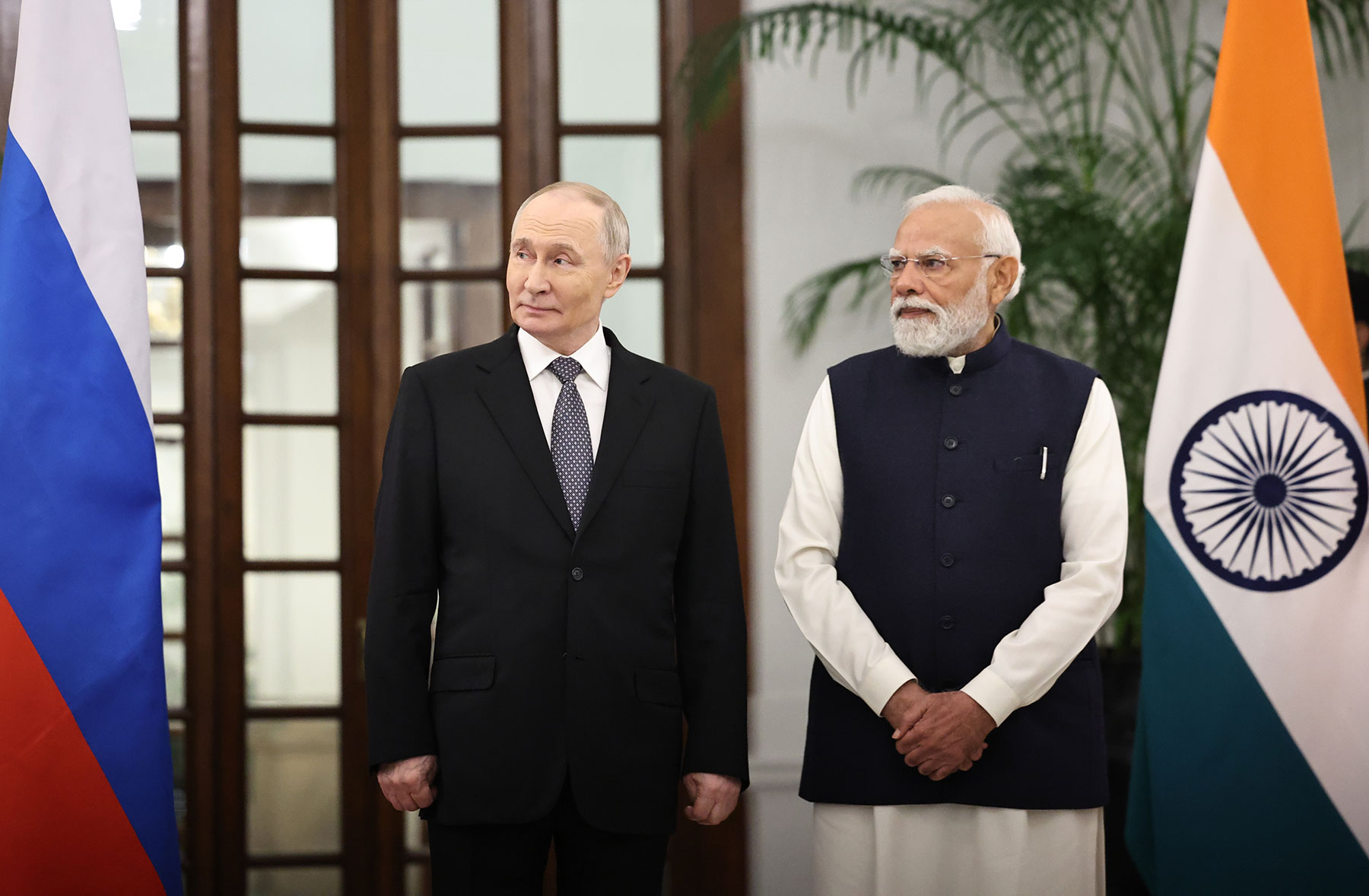
Bilateral engagement has taken on particular importance this year. Indian diplomacy is working tirelessly on all fronts, including with the U.S., Canada, and Japan. Yet the importance of relations among Russia, India, and China cannot be overstated: they form the backbone of BRICS while extending far beyond it. Contacts between the leaders of India and Russia have perhaps never been so intensive. In December 2025, Vladimir Putin made a productive visit to Delhi; in August, Putin and Narendra Modi met in Bishkek on the sidelines of the SCO summit marking the organization’s 25th anniversary. The Indian leader’s attendance in person was also significant: following another deterioration in relations with China caused by the 2020 border clashes, India held the concluding summit of heads of state virtually during its 2023 SCO Chairmanship, while Foreign Minister S. Jaishankar represented India at the July 2024 summit in Astana. Before the BRICS summit in New Delhi, Putin and Modi not only found time to meet but also visited the Russian-Indian INNOPROM exhibition, which showcased leading Russian companies and their most promising high-tech projects geared toward India. The two leaders set themselves and their governments the task of moving from continuity in relations to their accelerated development. Work has therefore intensified across all areas, particularly on the wide range of issues concerning economic, scientific, and technological cooperation. The two sides are discussing a new investment protection agreement; negotiations on an India–Eurasian Economic Union free trade area continue; and the United Aircraft Corporation is putting together a package of agreements on localizing production in India and supplying Russian-designed civilian aircraft to Indian regional airlines. Before the end of 2026, Putin and Modi will hold another round of their annual bilateral talks in Moscow.
Stability along the border is India’s primary condition for normalizing relations with China. On September 12–13, 2026, Chinese leader Xi Jinping visited India for the first time in seven years. He not only took part in the BRICS summit, standing alongside Narendra Modi in the official summit photographs, but also brought an impressive delegation of more than 400 officials and businesspeople. Key milestones on the difficult path toward improved Indian-Chinese relations included the BRICS summit in Kazan in October 2024, when signs of normalization became publicly apparent, and the SCO summit in Tianjin in September 2025, where Modi, Xi, and Vladimir Putin displayed a particularly friendly rapport. In parallel, special representatives from both sides worked with an understanding of the strategic importance of normalizing ties. Direct flights between the two countries have now resumed, and reciprocal market access and several investment projects are under discussion.
India, Russia, and China serve as a crucial source of normalcy and predictability in contemporary international relations. They have also become the driving force behind economic integration within BRICS and are ready to share their experience with other participants. Trade among BRICS countries exceeded $1 trillion in 2025. Trade within BRICS is now growing faster than the global average and outpacing the group’s trade with external partners. Stronger ties between China and Russia, China and Brazil, and Russia and India have made the largest contribution. India is an important trading partner for all BRICS members and, for many, the second most important after China. BRICS countries account for 22% of India’s exports. Trade flows among India, Russia, Brazil, South Africa, and other African countries are still smaller than those with China but have considerable potential for growth. The UAE will also play an important role in expanding and diversifying trade within the group, despite the current crisis in the Middle East.
Taking stock of India’s 2026 BRICS Chairship, it must be noted that the challenges only reaffirmed the value of this forum. They allowed New Delhi to demonstrate outstanding diplomatic skills and draw on its wealth of experience in handling complex situations and working with a diverse range of partners. BRICS is gradually moving from a consultative and advisory club toward more concrete, carefully developed initiatives and the creation of mechanisms to implement them.
(votes: 2, rating: 5) |
(2 votes) |
What “new donors” bring to the table and whether their role in international development assistance is expected to grow
Toward More Balanced Russia–India Economic RelationsRIAC and Gateway House Report #113 / 2026
Roaring Lion’s Epic Fury Against Iran Highlight Limits of India’s Strategic AutonomyIndia’s actions are widely seen not as simple neutrality but as a deliberate attempt to identify areas of agreement, protect immediate national interests, and avoid being drawn into regional disputes, despite pressure from some to be more vocal
Doctrines of Progress: Trump, Xi, Putin, ModiNo new doctrine offers systemic solutions to the problem of alienation
African Countries in BRICS: New Opportunities for Economic and Political CooperationWorking Paper No. 97 / 2026